
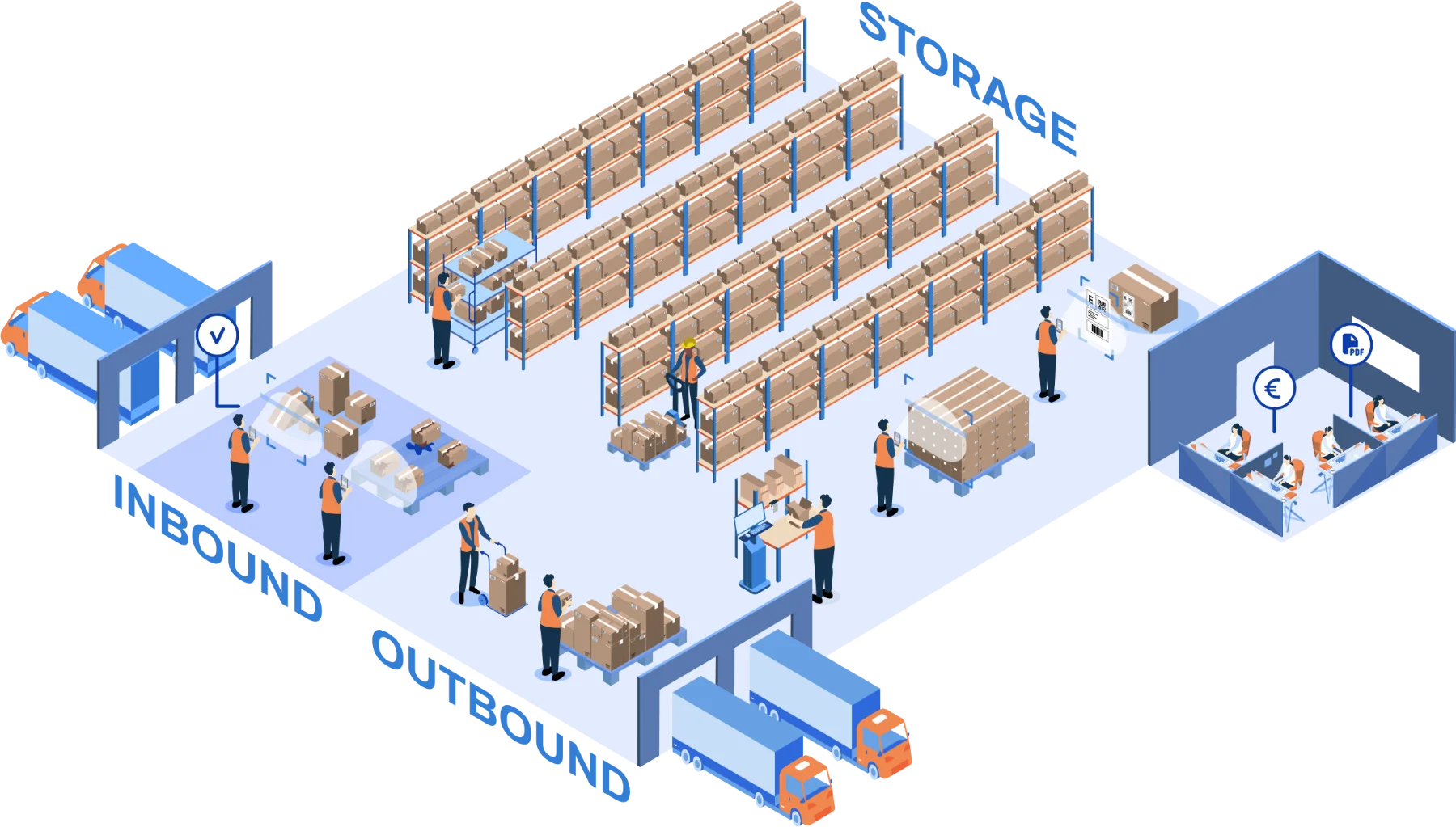






What is warehouse optimization?
Warehouse optimization is improving how a warehouse uses its space, people and equipment to handle more work, with fewer errors, at a lower cost.
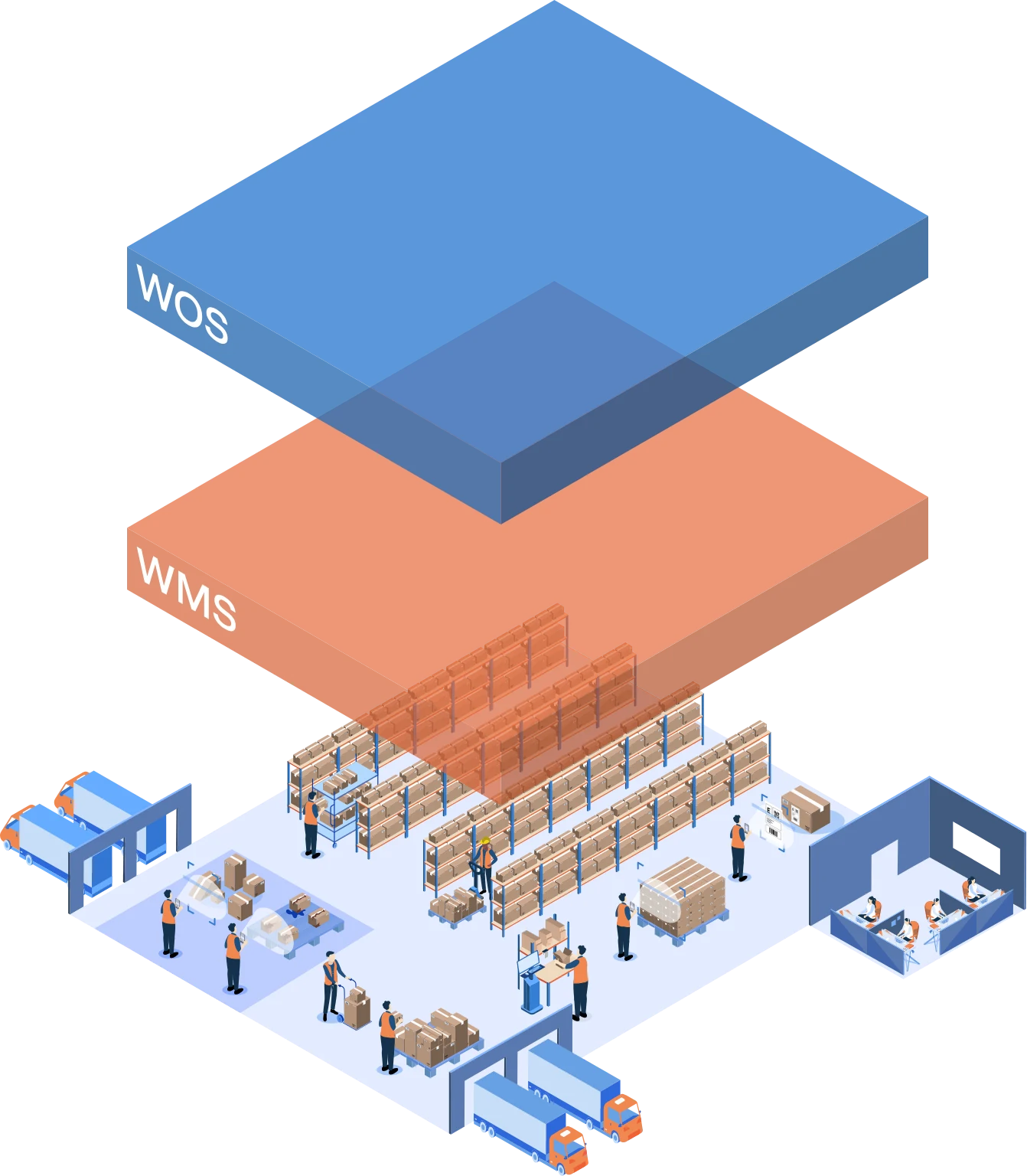
Warehouse optimization software (WOS) is the brain of the warehouse. It sits on top of the warehouse management system (WMS). Data flows up from the WMS, and the WOS decides what happens, when and how: where each SKU is stored, which orders are picked together, which route to walk and how each carton and pallet is packed. Those decisions flow back down to the WMS.
Same WMS. Smarter execution.
Where do you face challenges in your warehouse?
Inbound
Missing item master data
Dimensions, weights and units per case are missing or out of date.
Complete item master data can be captured at goods receipt.
Item master data standardManual measuring
Tape, pen and paper, or a trip to a fixed station. Slow and error-prone.
A mobile device captures accurate LxWxH of SKUs, parcels and pallets on the go.
Dimensioning methodsManual data entry
Delivery notes, bills of lading and labels are keyed in by hand.
AI reads documents and labels from a photo and fills in the fields.
Digitizing warehouse workBad data surfaces downstream
Wrong item data shows up later as repacks, failed put-aways or surcharges.
Validating data at capture stops errors before they spread.
Why dimensions matterPut-away and storage
Fast movers far from dispatch
High-velocity SKUs sit in locations that add travel to every pick tour.
Slotting optimization took one retail DC from 100 to 132 picks per hour.
What is slotting?Outdated slotting
Demand, assortment and seasonality changed. The location plan didn't.
Slotting optimization ranks re-slot moves, simulated on historical orders.
How to reslotStorage rules broken
Hazmat, temperature or weight limits get bent to find a free location.
Slotting can respect the storage rules of every SKU and location.
Storage location assignmentRunning out of storage space
Racks are full, yet prime locations hold slow movers and part pallets.
Re-slotting and consolidation free up capacity without adding racking.
Replenishment
Ad-hoc put-away
Incoming stock goes to the first free location, and the slotting plan erodes.
Each pallet can be directed to the best open location for its velocity.
ReplenishmentSame SKU in too many locations
Pickers visit several half-empty locations for the same SKU.
Consolidating locations frees up space and shortens pick tours.
Slotting gains fade quickly
Within weeks, day-to-day replenishment undoes the slotting plan.
Slotting optimization on every put-away keeps the layout from drifting.
Aisle congestion
Replenishment and picking compete for the same aisles at the same time.
A congestion heat map shows which aisles jam, and when.
Picking
High travel time
Walking between locations takes up most of each pick tour.
Order clustering and pick path optimization together cut walking by 30 to 55%.
Reducing travel timeFlat picks per hour
Extra staff and longer shifts don't raise productivity.
Better pick tours raise pick rates by up to 30%, with the same team and WMS.
Picking performanceHalf-empty pick carts
Orders are released one by one, so carts and totes leave half full.
Smart waving builds tours that fit each cart or equipment type.
Multi-order pickingPick sequence ignores packing rules
Heavy items end up on top of fragile ones in the tote or on the pallet.
Heavy first, fragile last: stable pallets with the least walking.
Packing
Ever-increasing transport costs
Carriers bill on volumetric weight, and the cheapest carrier varies per order.
Cartonization (cubing) compares carton and carrier options, so you see when 2 boxes are cheaper than 1.
Packing and carrier choiceDouble handling at packing
Items are picked into totes, then repacked into cartons or onto pallets.
Pick-to-box and pick-to-pallet put items straight into their final carton or pallet.
Pick and packInconsistent carton selection
Carton choice relies on judgment, so results vary from shift to shift.
Cartonization (cubing) picks the best carton per order: 15 to 30% less air.
CartonizationUnexpected carrier surcharges
Oversize and dimensional weight fees show up on invoices weeks later.
Carrier rules can be applied before a parcel leaves the building.
Calculating dim weightOutbound
Missed cut-off times
Orders aren't packed and staged by the time the carrier collects.
Waves can be released in line with each carrier's cut-off time.
Cut-off schedulingInconsistent mixed pallets
Pallets are built from experience, so no two come out the same.
Layer-by-layer build instructions cut one shipper's transport costs by 7%.
Mixed palletizingPoor pallet and trailer fill
Low, uneven pallets mean more pallets and more trucks than needed.
Palletization builds denser pallets, lowering transport costs by 10 to 30%.
PalletizationDamage in transit
Unstable pallets and poorly packed shipments lead to claims.
Stacking rules for weight and fragility keep pallets stable in transit.
Planning and people
Hard to hire and keep people
New and temporary staff take weeks to learn the layout and routines.
Visual, system-guided instructions help new staff get up to speed.
Peak capacity limits
The busiest weeks show where processes and space run out.
Peak volumes of 150 to 250% can be simulated on your own layout first.
Slotting before peakUnderused automation
Conveyors, sorters or robots run below capacity while manual steps queue.
Optimization can feed automation too, such as stacking plans for a robot.
Automation for 3PLsData without an action plan
Dashboards show what happened, not which change to make next.
A baseline of your own operation shows which change to make first.
Warehouse profilingEvery client wants different rules
One floor, many clients, each with its own picking and packing rules.
Different rules per client can run live, side by side.
Shipping cost unknown upfront
Webshops and sales quote shipping before the boxes or pallets are known.
The cheapest packing and carrier option can be calculated per order.
Quoting new business on estimates
Tenders are priced before anyone knows how the operation will run.
Simulating the prospect's own orders shows the productivity to quote.
Designing sites on paper
New layouts, equipment and volumes are decided without testing them.
A digital twin tests layouts, equipment and volumes before you build.
Digital twinsPicks per hour
Order lines picked per labour hour. The main measure of picking productivity.
Flat while volumes grow? The process is the limit, not the team.
Travel time per pick
Time or distance walked for each order line picked.
A high share of walking points to slotting and batching first.
Reducing travel timeDock-to-stock time
Hours from goods arriving at the dock to stock being available to pick.
Long times delay orders even when the stock is in the building.
Order accuracy
Share of orders shipped complete and without errors.
Every error costs a return, a reshipment and some goodwill.
Carton and pallet fill
How much of each carton, pallet and trailer is product rather than air.
Low fill means paying carriers to move air.
Cost per order
Total warehouse cost divided by the number of orders shipped.
The number that ties every change back to the yearly target.
How other warehouses started
Less air, lower transport cost with Pulse
Voltex implements 3D cartonization in pick-to-box operations across Australia and New Zealand sites.
Read the caseAdmin work from minutes to seconds with Flux
Van Moer Logistics digitize inbound checklists, dimensioning with Flux
Read the caseMedTech DC increases picking productivity 27% with Pulse
Pulse runs on top of their WMS. For the 60 operators picking 30'000 lines a day, nothing changed.
Read the case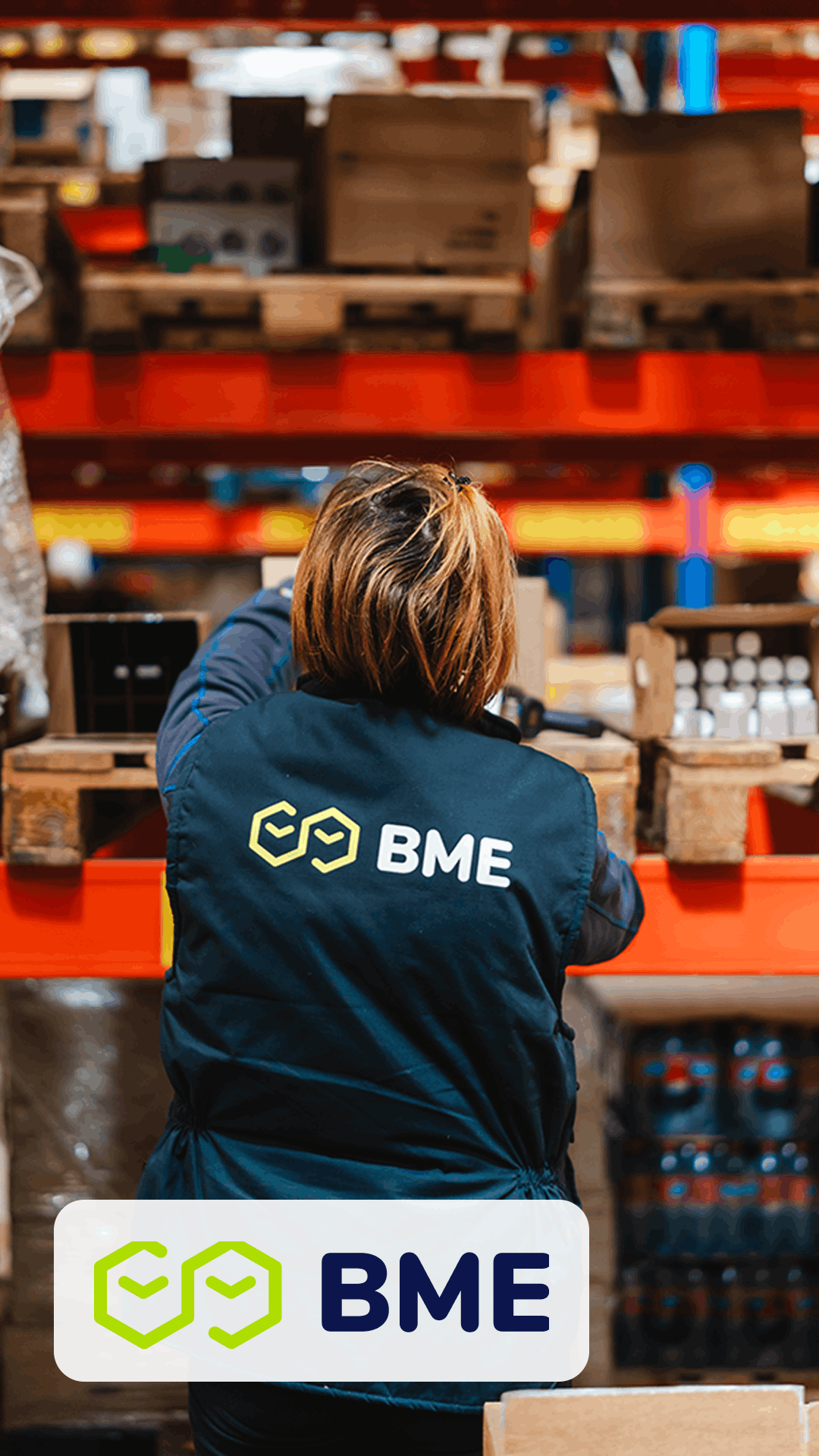
Static dimensioner gathering dust, replaced by Flux
BME Fulfillment capture LxWxH of SKUs at inbound and send master data to the WMS.
Read the caseNot sure where to start?
Talk to one of our warehouse optimization experts. We'll go through your operation with you and point out where to begin.
Questions?
Warehouse optimization is improving how a warehouse uses its space, people and equipment to handle more work, with fewer errors, at a lower cost. Warehouse optimization software (WOS) is the brain of the warehouse. It sits on top of the warehouse management system (WMS) and decides where each SKU is stored, which orders are picked together, which route to walk and how each carton and pallet is packed.
A WMS records stock, locations and orders and sends tasks to the floor. Warehouse optimization software works out the best way to do those tasks, such as which orders to batch, which route to walk and where each SKU belongs, and sends the result back to the WMS. You keep the WMS you have.
Start with a baseline: a few months of order lines, item data and locations. Check that dimensions and weights are complete, then focus on the process that takes the most labour hours. Test any change on your historical orders before it reaches the floor, or talk to one of our experts.
Picks per hour, travel time per pick, dock-to-stock time, order accuracy, carton and pallet fill, and cost per order. Measure them before a change and again after, so you know what the change did.
Start with a baseline of a few months of order lines, item data and locations, then work on the process that takes the most labour hours. Common levers are shorter pick tours, better slotting, the right carton or pallet for each order, and complete item data. Test each change on your historical orders before it reaches the floor.
No. Many gains come from changing decisions rather than equipment: how orders are batched, which route is walked, where stock sits and how cartons and pallets are built. Automation can make sense at high, stable volumes, and it runs better when the decisions that feed it are optimized too.
It depends on the change. New batching or pick routes apply from the next wave. Re-slotting takes longer because stock has to move, so it is often done in steps. Simulating a change on your own orders shows the expected result before anything changes on the floor.
Yes. Each client can keep its own picking, packing and shipping rules, and optimization can respect them side by side on the same floor.