


What is palletization?
Palletization is the process of stacking and arranging items on pallets for storage, handling, or shipment.
Warehouses, trucks, and material handling equipment are all designed around moving these palletized units. In essence, palletization transforms loose cartons into a single stable stack, making handling, storage, and shipping while protecting goods during transit easier.
By arranging boxes, cases or products on a pallet and then securing them, many individual items are consolidated into one “unit load.” This unit can be easily lifted by forklifts or pallet jacks and moved through the supply chain as a standardized block, rather than as separate pieces.

Why are items palletized?
Palletizing items is for cost-effective, safe, and efficient transportation. Instead of loading boxes one by one, grouping them on pallets brings multiple benefits for shippers and their customers. Main advantages of palletized shipping include:
- Cost Savings: Palletization speeds up loading and unloading. Forklifts can move an entire pallet in one go, reducing labor and turnaround time compared to handling individual boxes. For example, companies using palletized freight report up to 60% faster loading times. Faster handling means lower labor costs and shorter truck dwell times. Palletized loads also make better use of space in warehouses and trailers, allowing shippers to optimize freight costs by avoiding wasted space or dimensional weight charges in shipping.
- Minimized Product Damage: Proper palletization protects goods in transit. Stacks of boxes on a pallet are tightly packed and can be secured with stretch wrap, straps, or shrink wrap, preventing items from shifting or toppling en route. Fewer touch points (handling a whole pallet vs. many loose items) mean less opportunity for drops or impacts. In fact, palletized shipments experience significantly fewer damaged goods – up to 35% less damage on average. By keeping items stable and supported, palletization reduces crushing, shock, and vibration damage. This not only avoids costly product losses but also maintains customer satisfaction by ensuring intact deliveries.
- Load Stability and Safety: A well-palletized load is far more stable than loose cargo. Boxes are stacked evenly with a balanced weight distribution, lowering the center of gravity of the load. They can also be interlocked or wrapped to form a single unit that is less prone to falling over. A stable pallet is less likely to shift during sudden stops or on bumpy roads, reducing the risk of freight collapsing. And handling palletized loads keeps warehouse staff safer – workers use equipment (forklifts or pallet jacks) instead of manually carrying many small items, which lowers the risk of injuries from repetitive lifting.
Main factors in palletization design
Building a stable pallet load is both a science and an art, involving consideration of the characteristics of the products and the constraints of the pallet and supply chain. Logistics managers and packaging engineers must account for several factors when palletizing:
- Product Weight and Distribution: The weight of items and how that weight is distributed on the pallet are critical for stability. Heavy products should be placed at the bottom of the pallet, with lighter items on top, to lower the center of gravity and prevent top-heaviness. Exceeding a pallet’s weight capacity or creating an unbalanced load (e.g. all heavy items on one side) can make the pallet prone to tipping or collapsing. A single unstable pallet can even bring down a whole stack in storage.
- Product Dimensions: The size and shape of cases or items should fit efficiently on the pallet. Ideally, the combined footprint of the load matches the pallet dimensions with minimal overhang or empty space. Cartons that overhang the pallet’s edges lose support – any portion of a box that extends beyond the pallet isn’t supported from below, increasing the chance of that box corner being crushed. Too much empty space (underhang or gaps) can allow movement or require additional dunnage.
- Stacking Strength and Crushability: Each product (and its packaging) has a certain stacking strength – how much weight the bottom layers can bear before being crushed. This depends on factors like the sturdiness of the box (board strength, wall construction), the product inside (does it provide internal support or is it easily compressed?), and even environmental conditions (humidity can weaken cardboard). Corners of boxes are the strongest load-bearing points, so stacking patterns that align box corners (vertical column stacking) can support more weight before failing. If products are very crushable or fragile, there may be a maximum number of layers that can be stacked, or it may require placing sturdier boxes at the bottom and lighter, fragile ones on top. In mixed SKU pallets, this is a major consideration – workers (or software) must ask “Will this item crush what’s underneath?”. Sometimes protective measures like reinforcing boards, partition inserts, or stronger boxes are needed for weak items.
- Pallet Stacking Pattern: The pattern in which boxes are arranged on each layer and how layers align with each other affect both vertical strength and lateral stability. The two primary patterns are column stacking and interlocking (brick) stacking. Column stacking means each box is placed directly over the one below it in straight columns; this maximizes vertical load-bearing because the weight is transferred straight down through aligned box corners. Interlocking (or cross-tier) patterns, on the other hand, alternate the orientation of boxes in each layer (like a brick wall) so that each box overlaps with those below it. This “locks” layers together and improves lateral stability, reducing the chance of boxes swaying or sliding in transit.
- Overhang and Alignment: Special attention is given to avoiding overhang, as noted above, because it severely compromises support. Boxes (typically) should not extend beyond the pallet edges; even an inch or two of overhang can reduce a carton’s compression strength by a large percentage, increasing the risk of corner crush and pallet collapse. Additionally, misalignment or uneven stacking (where corners don’t line up or layers aren’t flat) can create pressure points and weak spots.
Single-item vs. mixed-case palletization
Palletization methods can be broadly categorized into: (1) pallets with a single product type, and (2) pallets with a mixed assortment of products. Each approach is used in different scenarios and comes with its own challenges.
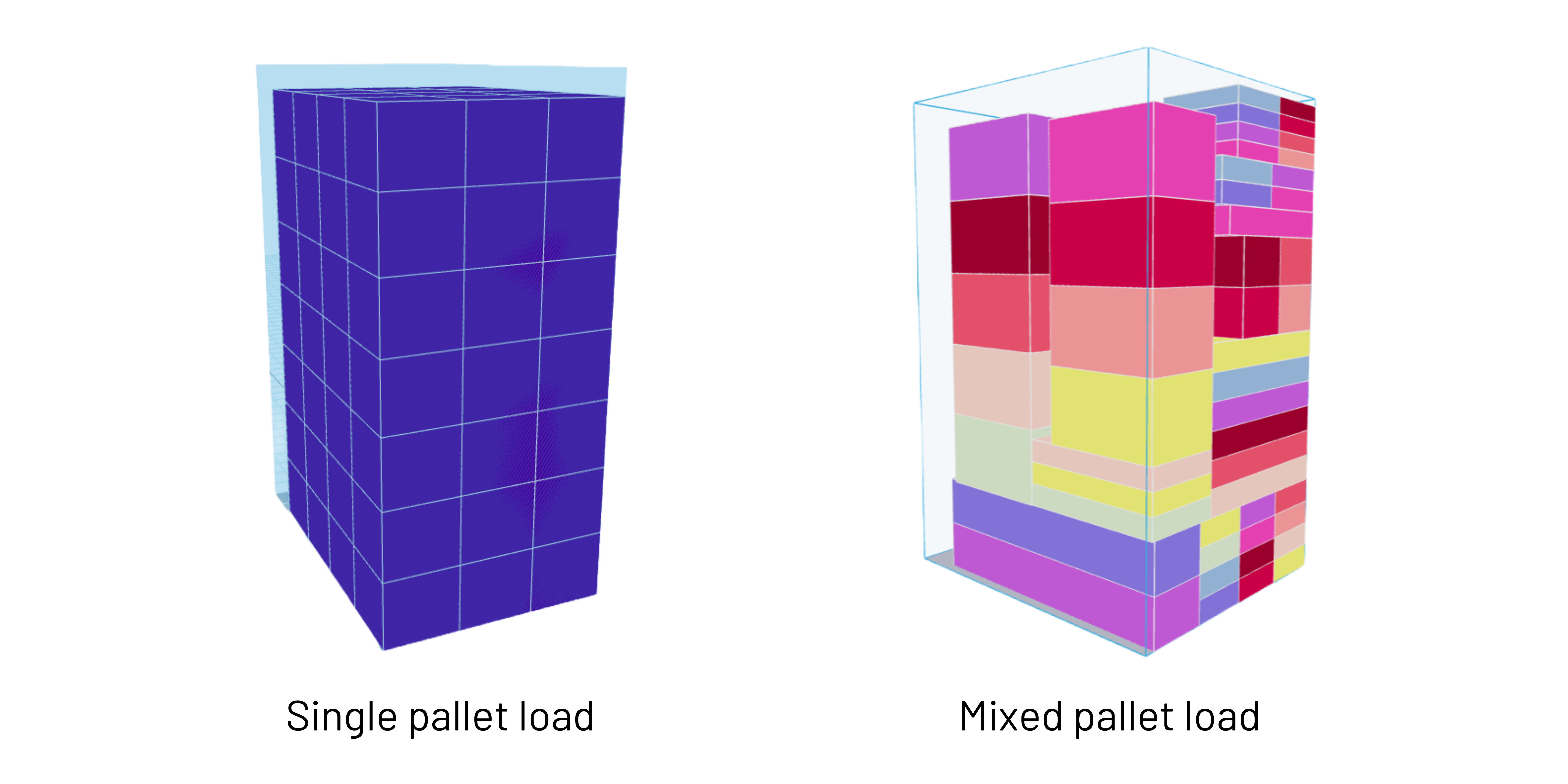
Single-SKU pallets
A single-SKU pallet contains only one kind of product or SKU (Stock Keeping Unit). All boxes on the pallet are identical in size and content. This is common in manufacturing and bulk distribution, for example, a pallet full of the same bottled beverage or the same part number.
Because of its uniformity, single-SKU palletization is straightforward to plan and optimize. The stacking pattern can be designed once for that one box size, often achieving near-perfect pallet coverage with no overhang. Loads are typically very stable since every layer is the same and weight is evenly distributed. High-volume production lines often use robots to speed up the process - conventional palletizer machines can repeatedly stack identical cases in a precise pattern.
The downside is less flexibility: single-item pallets work when you’re shipping large quantities of the same product, but are inefficient if an order or delivery needs a variety of products.
Mixed-SKU pallets
A mixed-SKU or mixed-case pallet contains a variety of different products on the same pallet. This method has become increasingly important in retail, e-commerce, and distribution centers where outbound orders combine many product types destined for the same location.
Modern store deliveries and e-commerce shipments rarely consist of a single SKU, so pallets must be “built” with an assortment of cases.
Mixed palletizing is far more complex. It involves stacking items of different sizes, weights, and packaging together on one pallet. The goal is to make a stable, space-efficient pallet despite the variety.
This means carefully sequencing and arranging different cases or boxes: heavier and sturdier items at the bottom, fragile or light items on top.
A mixed pallet might have each layer composed of a Tetris-like arrangement of various box sizes. It requires intelligent planning to avoid gaps and overhang while maintaining stability. Mixed-case palletization is labor-intensive and skill-intensive when done manually, workers must constantly decide which item to place next and where, balancing weight distribution and not crushing anything underneath. This is why fulfilling a store order with dozens of SKUs on one pallet is much harder than stacking identical boxes.
When adding a second problem of navigating the warehouse aisles during mixed-case pallet building (pick-to-pallet), the process becomes a whole different level of complexity.
Nevertheless, mixed pallets are hugely beneficial: they allow a single pallet to carry everything a destination (like a retail store or an e-com customer) needs, instead of shipping many half-empty pallets of individual products. Increasingly, companies look to automation and software to assist with mixed-case palletization because humans find it difficult to consistently build optimal mixed pallets for thousands of different order combinations.
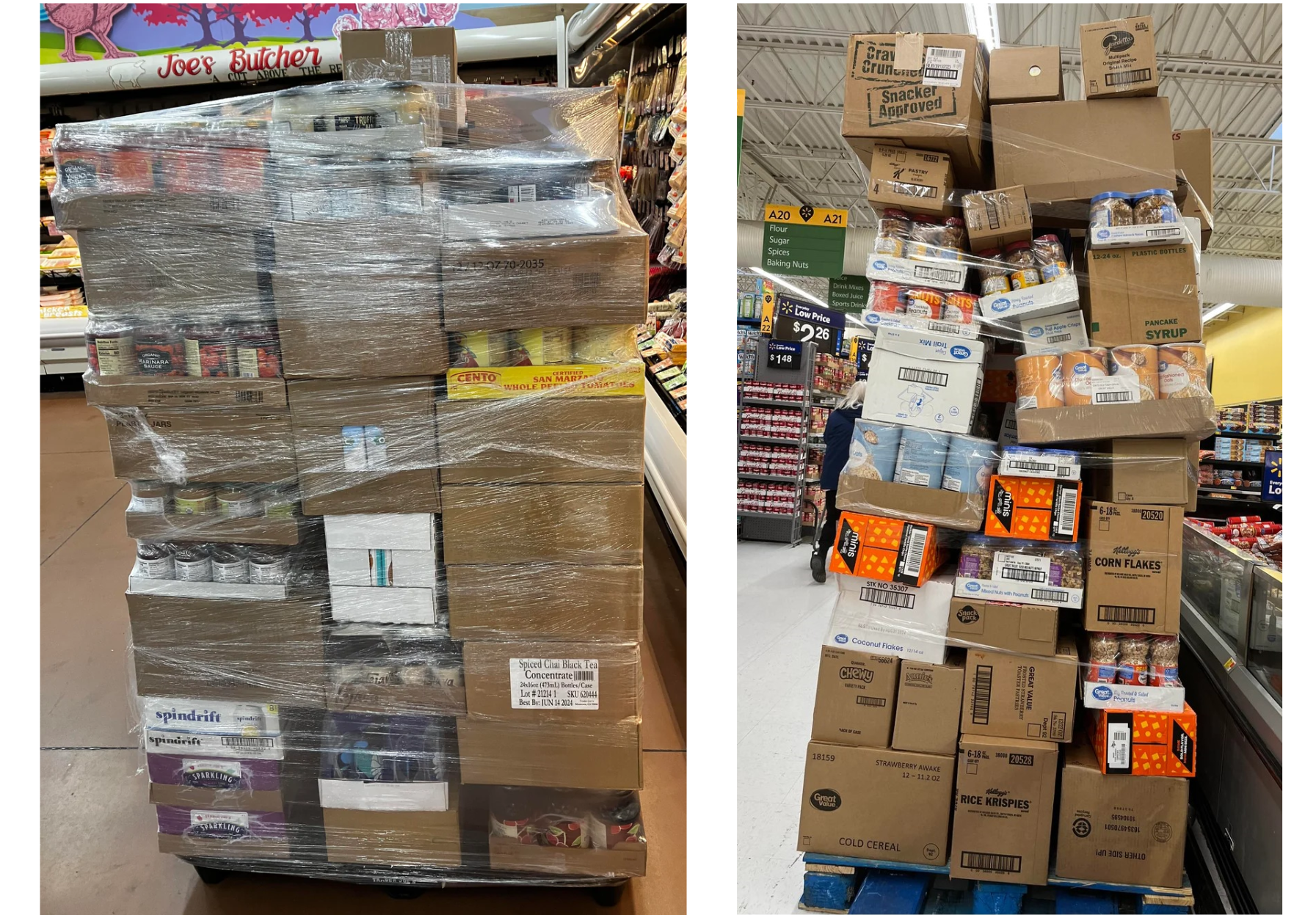
From manual to fully automated pallet building
Pallets can be built manually, with assistance from software and equipment, or entirely through automation. Each approach offers different trade-offs in terms of speed, cost, and flexibility:
- Manual palletization relies on human labor for stacking and pattern decisions. It's flexible and low-cost to start but labor-intensive and harder to scale.
- Semi-automated systems combine people with tools like lift assists or 3D palletization software, which helps workers follow optimal stacking plans for speed and consistency.
- Fully automated palletizing uses robots or mechanical systems to build pallets with minimal human input. It’s best for high-volume or standardized operations, offering unmatched consistency and throughput.
Read the full breakdown here: Mixed Palletization: Types, Technologies, and When to Automate.
3D Palletization Software
Relying purely on manual judgment is often not enough. Assistance in pallet planning has gone from a “nice to have” to a near necessity for complex operations.
Helping warehouse operators, semi-automated and automated systems is 3D palletization software.
These programs can determine the best way to arrange a given set of items on a pallet, often using 3D modeling and optimization algorithms.
For instance, given an order with a mix of SKUs, palletization software will calculate an ideal stacking sequence that meets all the constraints (weight distribution, no overhang, stacking strength, truck height limits, etc.) and yields a stable, dense pallet. Software like Pulse by Optioryx (a 3D palletization tool) can simulate pallet builds in a virtual environment and output step-by-step stacking instructions or even directly control robotic palletizers.
By using such tools, companies improve pallet layouts beyond what even experienced workers might achieve by trial and error. It enables better decision-making in real time – whether guiding a person or a robot – which leads to more stable pallets, fewer damaged products, and lower transport costs (by fully utilizing each pallet’s capacity).
3D palletization software gives every warehouse the ability to pack like a Tetris grandmaster, consistently and quickly.
Summary (TL;DR)
Palletization is the process of stacking goods on a pallet to form a single unit load for easier, safer, and more efficient shipping. It reduces transportation costs, minimizes product damage, and improves warehouse handling. Effective palletization considers factors like weight distribution, box dimensions, stacking patterns, and overhang. Methods include single-item and mixed-case palletization, using manual labor, software-assisted tools, or fully automated robotic systems. Smart 3D palletization software helps optimize pallet builds for cost, safety, and stability.
Questions?
Palletization is the process of stacking products on a pallet to make them easier and safer to move, store, and ship.
Companies palletize shipments to reduce handling time, lower shipping costs, prevent product damage, and improve load stability during transport.
Palletization helps fill warehouses and trucks more efficiently and reduces the time and labor needed to load and unload goods, which cuts transportation costs.
When building a pallet important factors include product weight, box size, stacking strength, overhang, and the pattern used to arrange items on the pallet.
Overhang happens when boxes stick out past the edge of the pallet. It can lead to damaged boxes and unstable loads during shipping.
Single-item palletization uses only one type of product on a pallet, while mixed-case combines different products on the same pallet for delivery.
3D palletization software calculates the best way to stack items on a pallet by considering size, weight, and stability. It helps reduce damage and make better use of space.