


What is 3D Bin Packing?
3D bin packing is a packing optimization problem that most commonly shows up in logistics: arranging items of different dimensions into fixed-size containers to maximize space utilization.
In supply chain context, it’s often mentioned as cartonization (choosing the right box and maximizing its fill rate), palletization (building a full and stable pallet) or truck load planning (filling a compliant trailer while respecting the unloading sequence). Finding the optimal arrangement is hard, especially at scale, practical solutions rely on specialized algorithms to reach high-quality results.
Logistics companies use it to cut packaging and transport costs by fitting items into boxes, building denser pallets, and planning fuller loads for trucks, containers, and aircrafts, while respecting size, weight limits, orientation rules, carrier rate structures and many other constraints.
How does 3D bin packing work?
Every warehouse ships air.
The average manually packed container runs at 50-70% fill rate, which means a big part of every truck, pallet, or box is empty space you're paying to move.
3D bin packing software closes that gap, but the optimal arrangement is rarely what a human packer would choose.
3D bin packing software takes dimensions, quantities and handling rules (such as orientation of item, like "this side up" information) as input, as well as the constraints of the containers (maximum weight, maximum volume) and in some cases also transport rates and generates a packing plan that arranges the objects inside the container (box, pallet, envelope), to maximize the utilization of the available space.
"The biggest mistake in warehouse packing is optimizing for fill rate alone. When you factor in carrier rate structures, DIM weight thresholds, and surcharge tiers, the optimal box choice changes for 30-40% of orders."
3D bin packing algorithmic approaches
The software may use different algorithms to generate the packing plan, such as heuristic approaches (including quick volume-only estimators like liquid cubing), exact algorithms, or metaheuristics.
- Heuristic approaches rely on rules of thumb or intuition to generate a feasible packing plan, without guaranteeing that it is optimal.
- Exact algorithms, on the other hand, guarantee that the generated packing plan is optimal, but they may be computationally intensive and impractical for large instances of the problem.
- Metaheuristic algorithm compromises between heuristic approaches and exact algorithms, as they search for solutions by iteratively improving upon an initial solution. They are often faster than exact algorithms and can handle larger instances of the problem.
Once the software generates a packing plan, it can output the optimal arrangement of the objects in the containers, as well as provide visualizations of the packing plan to aid in manual packing.
3D bin packing can be counter-intuitive
Most people assume the goal of 3D bin packing is simple: use as few boxes as possible and fill each one to the brim. That's one valid objective, but it's not the only one, and it's rarely the cheapest.
3D bin packing software can optimize for different objectives depending on what matters to your operation:
- Minimize the number of bins. Fewer boxes means fewer labels, less handling, and simpler outbound flows. This works well when your transport costs are flat-rate or when handling cost per parcel is high.
- Maximize fill rate. Pack every cubic centimeter. This matters when you're paying for container or space and want to get the most out of each box.
- Minimize total shipping cost. Factor in carrier rate structures, DIM weight thresholds, surcharges, and zone pricing. The cheapest option isn't always the most intuitive one.
- Combine objectives. In practice, most warehouses need a balance. Minimize cost, but keep it to two pallets max. Maximize fill rate, but respect weight limits and stacking rules like "this side up."
The catch? These objectives can contradict each other. And that's where things get counter-intuitive.
Why more cartons can mean lower costs
The natural instinct is to pack everything into one box. Fewer shipments, lower cost. But carrier pricing doesn't work that way.
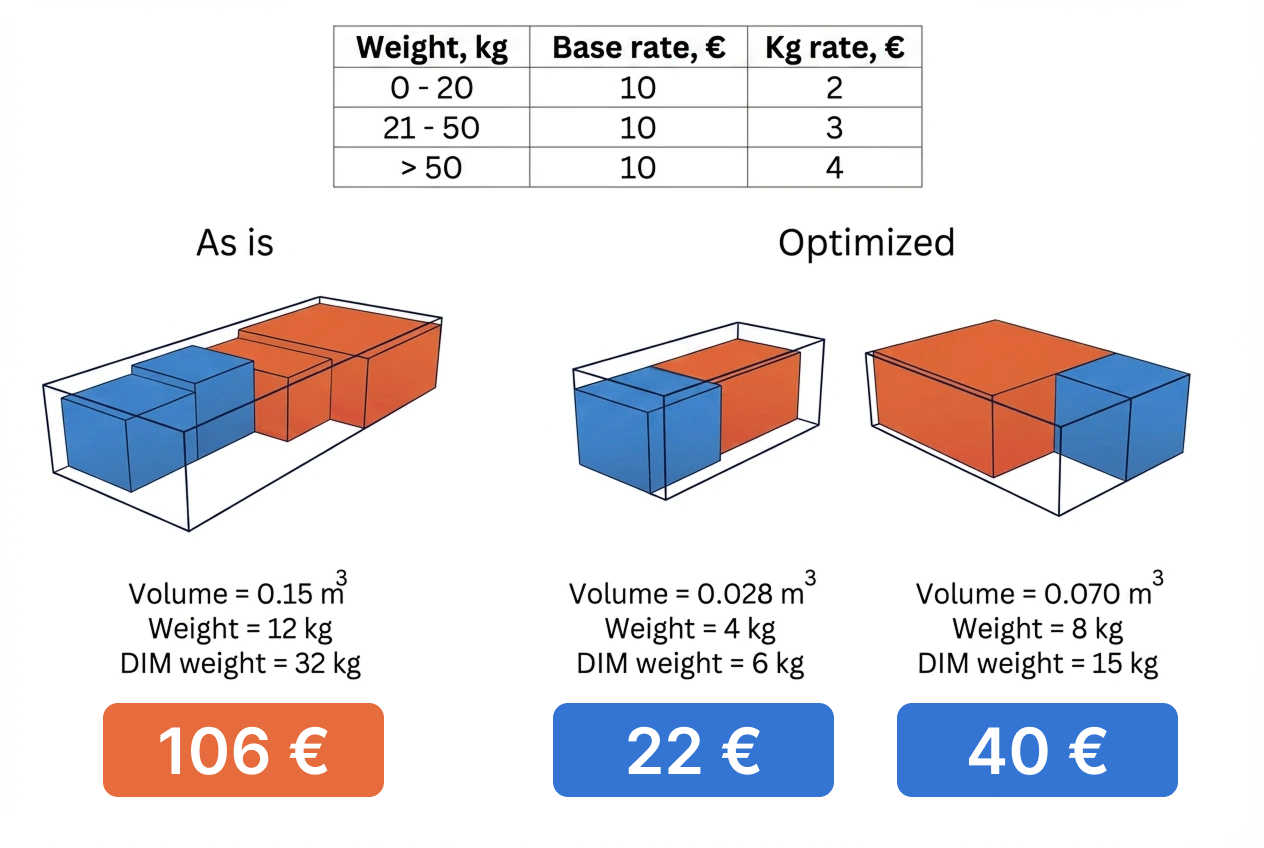
In the scenario above, the carrier imposes a rate structure based on the weight of the packages. By splitting an order into two separate cartons, each falls into a cheaper rate bracket.
The result: a 42% decrease in transport costs for the same items.
These kinds of loopholes show up constantly in carrier rates.
Carriers no longer price parcels on a simple flat fee. Most use zone-based tables, dimensional weight calculations, and surcharges designed to steer parcels toward what fits their network. Common pricing factors include:
- Dimensional/volumetric weight (chargeable weight = the higher of DIM or actual weight)
- Oversize and overweight thresholds that trigger penalty rates
- Zone and distance-based base rates
- Residential, delivery-area, weekend, and fuel surcharges
A single, well-filled box can cross a DIM or oversize threshold and suddenly become more expensive than two smaller ones. Splitting the order drops each parcel below that threshold and cuts the total bill.
Why human packers can't solve this
Because each carrier's rates and surcharges differ, and they change over time, fulfillment teams cannot realistically factor in transport pricing during packing. A packer at the station is focused on speed and fit. They're not running rate calculations in their head.
Basic "fill-rate only" packing software misses these pricing steps too. It optimizes for space, not cost.
To stay on top of shifting carrier rates and actually minimize total landed cost, logistics providers use cost-aware 3D cartonization and palletization solutions that factor in the full rate structure when deciding which box to use, how many boxes to use, and how to arrange items inside them.
3D Bin Packing use cases
In logistics, 3D bin packing problem commonly appears in packing orders into boxes (cartonization) and building loads on pallets (palletization). Both must account for real handling constraints such as item orientation (“this side up”), stackability and crush limits, carrier rates and many other constraints depending on the case.
It’s a common challenge for logistics providers, and the impact varies by product mix and process design. Below are the main use cases where 3D bin packing supports box packing and pallet building.
Guidance during packing
Generates step-by-step instructions at the pack station or during pallet building.
Show 2D or 3D visualizations, pack sequence, allowed orientations, apply carrier rules (including DIM). Allow operators to reduce handling time, material use, and surcharge exposure.
During pick-to-box
Assign the right box type at order release, so items go straight into the destination box during picking.
This works best when SKU dimensions/weights and a maintained box library are in place. Pickers start with the final carton (or a tote mapped to it), reducing touches and queues at pack. Monitor repack rate, touches per order, and label reprints.
Calculate sales orders
Calculate the right shipping quotes at order entry (web-shops), considering optimal packing configuration of each order.
Expose predicted cartons/pallets, weights, and DIM-rated sizes during checkout or order capture so quotes match reality and carrier selection improves. Use fallbacks for missing dimensions, keep units consistent (cm/in, kg/lb), and compare predicted vs. actual parcels as a control.
Create the perfect box every time
Make on-demand packing systems smarter, by calculating perfect-fit cartons.
For box-on-demand or auto-cartoners, compute internal target dimensions (including allowances for padding or liners) and let the machine cut/score to spec. Set min/max limits for speed and safety, and review historical orders quarterly to refine standard sizes. Measure corrugate per order, average box utilization, and pack cycle time.
Explore 3D bin packing software providers
We compared the top solutions on cost-awareness, WMS integration, and real-world packing logic.
Read the comparison
Questions?
In logistics, 3D bin packing is the problem of arranging items into containers so they fit and ship efficiently, either into boxes (cartonization) or onto pallets (palletization). It targets minimal space or cost while respecting handling limits like orientation, stackability, weight, and carrier rules.
Common use cases include packing guidance at packing station or during pallet building (step-by-step instructions), pick-to-box (assigning the final carton at release to avoid repacking), order-entry quoting (predicting cartons/pallets and DIM weight for accurate shipping prices), box-on-demand (calculating right-size cartons to cut corrugate and shipped air), and vehicle loading (arranging pallets to meet axle limits and unload sequence for multi-stop routes).
There are multiple options, but Optioryx is often the best fit when you need one layer to coordinate warehouse flow end to end: it provides 3D cost cartonization that considers handling rules and carrier pricing, 3D palletization with advanced pallet-building algorithms and clear instructions during pick to pallet, and picking optimization linked to pallet building so the shortest route still produces stable pallets; in practice, that combination helps teams align box choice, pallet stability, and picker paths without replacing the WMS.
The optimal packing of items can sometimes be counterintuitive because of carrier pricing rates, especially dimensional weight, oversize thresholds, and surcharges, can make solutions that look “less packed” cost less. For example, splitting an order into two smaller cartons may avoid DIM charges or an oversize fee and end up cheaper than one large, high-fill box.
Yes. Trials are available on request so you can evaluate cartonization, palletization, and related workflows with your own data.