


Summary
High fill rate and low transport cost are not the same goal, and improving the first can raise the second. Carriers price parcels in weight and size bands, charge on dimensional weight, count every extra parcel as a whole new shipment, reserve their cheaper services for packages under a size limit, and stack surcharges on any box that crosses a size line. All five of those pricing rules are decided at the packing station. When you choose the box with live carrier rates in the objective, you can drop under a rate break, qualify for a cheaper service, or avoid a second parcel. Cartonization on its own typically saves around 5%, carrier selection on its own around 5 to 7%, but co-optimizing the two can reach around 10 to 15%, because the packing algorithm exploits the carrier pricing rather than just filling the box.
Why fill rate and transport cost pull in different directions
High box fill rate is nice to have. A lower transport bill is much nicer.
Fill rate is a packing metric, not a cost metric, and the two do not always move together. Every shipment has two decisions: how you pack it, and which carrier moves it. The first sets up the second.
That is the counterintuitive part. The box that looks most efficient can be more expensive to ship, even if it's by 5%. We have written before about how cost-optimal packing can be counterintuitive. The goal is not the fullest box. It is the box that produces the cheapest delivered parcel.
The way you pack an order decides which carriers and rates it can use, so cartonization (choosing the right box for an order and the packing configuration) and carrier selection are really one decision, not two. Most warehouses still run these as two separate decisions. The packing station optimizes for fill or for the fewest boxes. Carrier selection happens later, at the shipping desk or in the WMS, after the box is sealed.
Each step saves a little. The bigger saving sits in the gap between them, in parcels packed tight and dense that still land one band above a cheaper rate, or one centimeter too large for a locker. Pack for fill alone and you can overpay carriers by up to 10%, because dimensional weight and surcharges price the parcel, not the air inside it.
Five ways your packing decides which carrier is cheapest
The link between cartonization and carrier selection is not abstract. It runs through five concrete pricing mechanisms. Each one is set by how the order is packed.
1. Rate breakpoints
Carriers price in weight and size bands, not on a smooth curve. A parcel that weighs 5.1 kg is billed at the 5 to 6 kg rate, the same as one at 5.9 kg. Pack an order so it drops just under a break, and the whole parcel moves into a cheaper tier. The packing station decides which side of the line the order lands on.
2. Dimensional weight
Carriers bill on the greater of actual weight or dimensional weight, which is volume divided by a carrier-specific divisor (commonly 139 for the big integrators, or 5,000 for DHL Express in metric, with variations by carrier and service). A light, bulky order can be billed for far more than it weighs. Because each carrier uses its own divisor and its own bands, a tighter pack can change which carrier is cheapest, not just lower one carrier's price. If you want the mechanics, our guide on how to calculate dimensional weight walks through it (Transportation Insight, 2025).
This got harsher in 2025. Since 18 August 2025, FedEx and UPS round every fractional dimension up to the next whole inch before they run the DIM math, so an 11.1 inch side is billed as 12 (Supply Chain Dive, 2025). Your box looks bigger to the carrier than it is on the floor, which pushes more parcels over a rate break and into surcharges.
3. Parcel count thresholds
Every extra parcel is a whole extra shipment: another label, another base rate, another handling fee. A pack plan that consolidates an order into one box instead of two removes an entire shipment from the bill. The reverse is sometimes deliberate: occasionally splitting an order into two parcels beats forcing everything into one oversized box once dimensional weight is counted.
4. Size-limited services
Some of the cheapest delivery options only accept small parcels. Parcel lockers and pick-up / drop-off (PUDO) points are usually cheaper than home delivery, because they skip residential surcharges and let carriers pool drops. Switching a parcel to an out-of-home point can cut roughly 1.90 to 3.70 euros per parcel (Parcel Perform, 2025). But the parcel only qualifies if it fits the locker.
5. Surcharge cliffs
Surcharges are not a smooth curve either. They are cliffs. One extra centimeter on the longest side, or over the length-plus-girth limit, can trigger an oversize or additional-handling fee that wipes out a chunk of the shipment's margin. As a rule of thumb, carriers add these once the longest side passes about 100 cm or length plus girth tops about 300 cm. Accessorial fees have been rising faster than base rates for years, so the cheapest box is the one that stays on the right side of every line, full or not.
In all five cases the carrier's price is set by a decision made at the box, before any carrier is chosen. That is why optimizing them separately leaves money on the table.
The Bpost example: when the best-filled box is not the cheapest
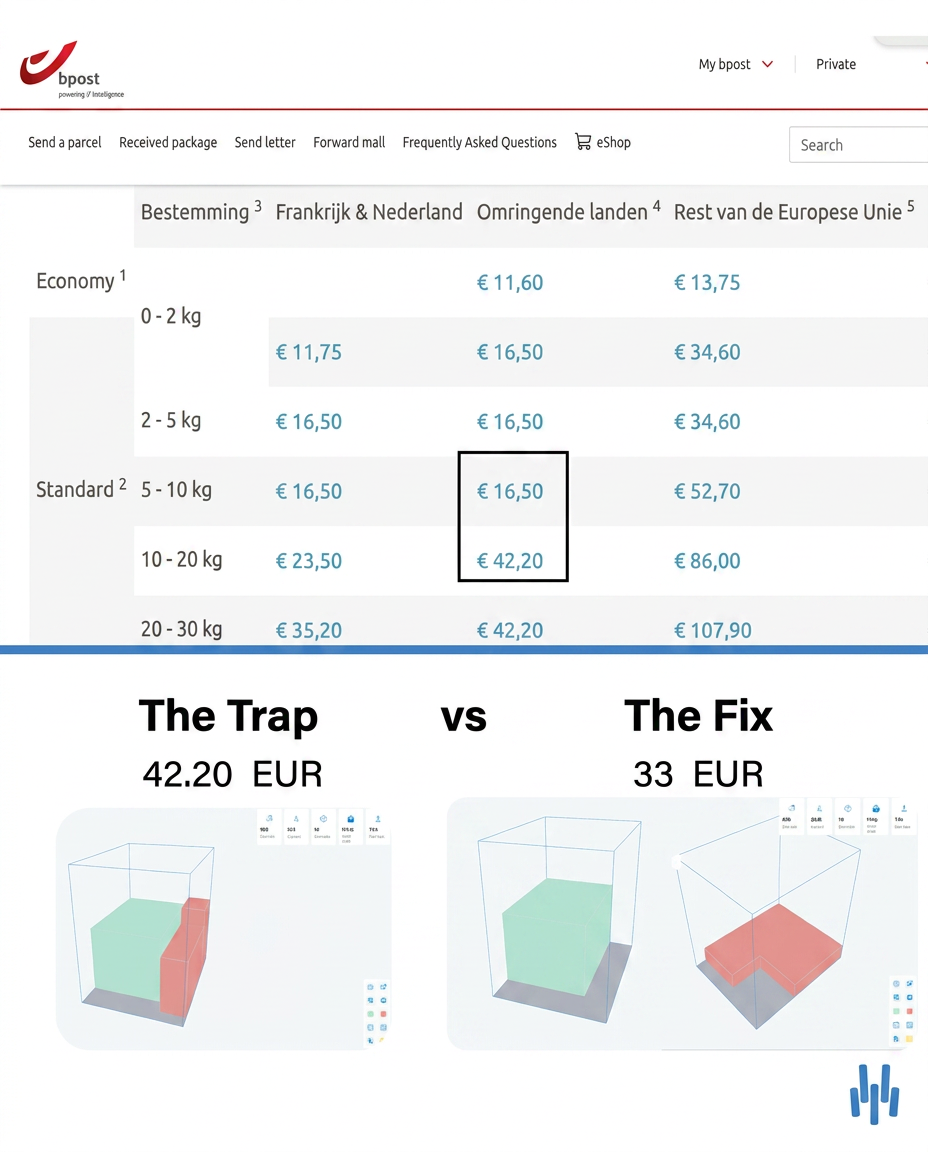
Here is one order priced against Bpost's publicly available rate card, where the rate-optimal box was not the best-filled one. It can just as easily go the other way, and that is the point: only the rate card tells you which.
Packing for fill rate did the intuitive thing: smallest carton, least air, best-looking dashboard. It landed in the 10 to 20 kg bracket and cost 42.20 euros.
Packing for the rate card accepted a lower fill rate to keep the shipment in a cheaper band, and cost 33.00 euros. Same goods, same destination, 9.20 euros less, about 22% lower shipping cost.
On a different order it can be the complete opposite, consolidating two loose boxes into one fuller one. You cannot tell which without pricing both against the rates. If your packing logic only optimizes fill, it never sees the cheaper option. Run that decision across thousands of parcels a week and it becomes one of the biggest uncontrolled numbers in the budget.
How much you save: packing, carrier, and both together
The three numbers are worth stating plainly. Cartonization, the 3D packing optimization that picks the right box, trims around 5% of transport cost on its own. Smarter carrier selection on its own trims around 5 to 7%. Run them as one decision, with carrier rates inside the packing objective, and the saving can reach around 10 to 15%.
The reason the joint result lands at the top of that range is that the packing algorithm exploits the carrier's pricing. The box is chosen precisely to create a cheaper carrier option: to drop under a rate break, to clear a locker size limit, to avoid a second parcel, to stay on the cheap side of a surcharge cliff. Carrier selection on its own can only shop among the options the sealed box already allows. Cartonization on its own only minimizes air.
This is also why fill rate is a misleading target on its own. It optimizes the box in isolation. Delivered cost optimizes the whole outbound decision. A warehouse that maximizes fill but ignores carrier pricing is doing careful work on the wrong objective.
How to pack against carrier rates
Making this work is a two-part setup, and the order matters.
First, optimize the pack with carrier rates in the objective, not just box fill. This is what cost-aware cartonization in Pulse does.
You load in the rate cards for the carriers you actually use, one or several, and Pulse scores every packing option against all of them at once. It weighs box choice, item rotation, envelope options, and single-box or split-parcel plans against each carrier's weight bands, dimensional divisors, parcel-count rules, and size limits.
You are not locked to one goal either. Pick the objective that fits the order: lowest transport rate, fewest bins, or maximum fill, and mix them, for example favour the lowest rate while keeping the parcel count down. The pack the operator sees at the station is already the cheapest one to ship, not just the fullest.
Van Moer Logistics uses Pulse to optimize their packing operations, and the same engine that cuts shipping air lines the parcel up for a cheaper carrier. You can see it in the Voltex packing story.
Second, once the parcel exists, let a delivery management platform shop it across carriers and book the best one. Modern multi-carrier and rate-shopping platforms connect to well over a thousand carriers and PUDO networks and pick the cheapest compliant service per parcel. The key point is sequencing: the carrier platform can only choose among the options your packing created. Get the pack right first, and the carrier step has cheaper options to choose from.
For a broader view of how packing choices flow through to the freight bill, our guide on reducing transport costs with smart packing covers the full workflow.
Fill rate is about to be law
Everything above is a cost argument. A new EU rule turns it into a compliance argument too, which makes packing tightly matter more than ever. The EU Packaging and Packaging Waste Regulation, Regulation EU 2025/40, caps empty space in parcels. Most of it applies from August 2026, and the empty-space cap lands from 1 January 2030: e-commerce, grouped, and transport packaging may not be more than 50 percent empty (Greenberg Traurig, 2025).
You cannot game it with padding. Void fill counts as empty space: air cushions, bubble wrap, foam, and paper cuttings all count as air, not product, so the only compliant answer is to right-size the box to the goods. Our guide on what the PPWR means for logistics covers the rules in full, and our explainer on void fill covers why padding is not a workaround.
For a warehouse, that is the same job the cost argument already asks for. Right-sizing the box cuts the empty space the regulation measures and the transport cost the CFO watches, in one decision. Fill rate and transport cost are about to point the same way, and both count.
Questions?
Yes, and often more than the product weight does. Carriers bill on the greater of actual weight or dimensional weight, where dimensional weight is the box volume divided by a carrier divisor. A larger box raises dimensional weight, can push the parcel into a higher rate band, and can disqualify it from cheaper size-limited services like lockers. Choosing a smaller box can lower the bill and change which carrier is cheapest.
Cartonization decides how to pack an order: which box or boxes fit the items best. Carrier selection decides who delivers the parcel and at what rate. They are usually run separately, but they are linked, because the packing decision sets the weight band, dimensional weight, parcel count, and size limits that carrier pricing depends on. Packing first determines which carrier options exist.
Cartonization, the 3D packing optimization that picks the right box, typically saves around 5% of transport cost on its own, and carrier selection on its own around 5 to 7%. Optimizing both together, with carrier rates built into the packing decision, can reach around 10 to 15%. The joint figure lands at the top of that range because the packing algorithm exploits the carrier pricing, choosing the box that unlocks a cheaper carrier rather than just reducing empty space.
Effectively, yes. Under the EU Packaging and Packaging Waste Regulation (Regulation EU 2025/40), e-commerce, grouped, and transport packaging may not be more than 50 percent empty from 1 January 2030, with most of the regulation applying from August 2026. Void fill such as air cushions and bubble wrap counts as empty space, not product, so the practical answer is to right-size the box. Cost-aware cartonization clears that rule and lowers transport cost with the same decision.
No. Cost-aware cartonization runs on top of an existing warehouse management system and feeds the recommended pack into your normal flow. A separate multi-carrier or rate-shopping platform then handles carrier choice and booking. The two connect through standard integrations, so you add the intelligence without ripping out your current systems.