


Summary
Void fill is the paper, air pillows, bubble wrap, foam or loose fill that goes into a shipping box to take up the space the products leave empty, so nothing shifts or breaks in transit. The filler itself is cheap per parcel. The larger cost is the empty space behind it: a box that needs a lot of void fill is too big for the order, and the carrier bills that size through dimensional weight. The most reliable way to reduce void fill is to choose a right-sized box for every order before packing starts, which is what cartonization software such as Pulse does.
Void fill usually gets attention when the paper roll runs out faster than expected, or when a customer posts a photo of one small item in a large box. Most of the money sits in the box choice behind the filler. In a 2024 study of e-commerce box sizing, Kandula, Roy and Akartunali found that "more than one-quarter volume of a typical e-commerce package comprises air and filler material."
From 2030 the EU adds a rule on top of the cost. Under the Packaging and Packaging Waste Regulation, void fill counts as empty space, and an e-commerce parcel may be at most half empty. Our guide to the PPWR for logistics covers the other deadlines in the regulation.
What is void fill in packaging?
Void fill is any material placed in a shipping box to occupy the space the products do not fill. Its job is to keep items from moving, so they do not hit each other or the box walls when the parcel is dropped, stacked or pushed through a sorter. A well-filled box also holds its shape better when other parcels are stacked on top of it.
The term overlaps with two others. Cushioning protects a fragile item from shock, while void fill takes up space, although bubble wrap and foam often do both. Blocking and bracing fixes a product in one position with cardboard, wood or foam blocks, which suits heavy or oddly shaped items. In freight the same idea at a larger scale is called dunnage: air bags or boards between pallets in a trailer or container.
How much void fill a box needs depends on the empty volume left once the items are in, on how fragile the items are, and on how rough the journey is. The warehouse controls the first of those directly, through the box it picks. A carton that matches the order leaves a few centimetres around the items. A carton one size too big can leave more empty space than product.
Types of void fill and what each one costs
Five types of void fill cover most warehouse packing stations. They differ in material price, in packer time per box, in the storage space they need before use, and in how firmly they hold items in place.
Paper void fill
Kraft paper is crumpled by hand from a roll or fed through a dispenser that crimps and cuts it into pads. Per volume of fill, paper is usually the cheapest option. A 2026 void fill comparison by Stanley Packaging, an Australian packaging supplier, calls paper "the most cost-effective option per unit of void fill created". It also goes into the normal paper recycling stream at the customer's end.
Air pillows
Air pillows are film bags inflated at the packing station by a small machine. A roll of flat film takes little storage space and turns into a large volume of fill, and the pillows add almost no weight to the parcel. The trade-off is the machine and a looser hold on the product, since pillows touch the items at fewer points than crumpled paper does.
Bubble wrap
Bubble wrap is mainly a cushioning material that also gets stuffed into gaps. It absorbs impact well around fragile items. As a pure space filler it is the expensive choice: it takes up a lot of room before use and costs more per cubic metre of fill than paper, according to the same Stanley Packaging comparison.
Loose fill
Packing peanuts in foam or starch, and shredded paper or cardboard, are poured around the items. Loose fill wraps around any shape, which helps with irregular products. It settles during transit, so heavy items can sink towards the bottom of the box, and it spills out when the customer opens the parcel.
Cardboard and molded inserts
Corrugated inserts, dividers and molded pulp trays hold each product in a fixed spot. Inserts work best for repeat shipments of the same items, such as a subscription box or a product that always ships alone. In mixed e-commerce orders every order has a different shape, so fixed inserts rarely fit.
| Type | Hold on the items | Storage before use | Equipment | Cost note |
|---|---|---|---|---|
| Paper | Firm when crumpled tightly | Roll or fan-fold stack | Optional dispenser | Cheapest per volume of fill |
| Air pillows | Looser, fewer contact points | Compact film roll | Inflation machine | Machine cost up front |
| Bubble wrap | Good cushioning | Bulky | None | Costs more per m3 than paper |
| Loose fill | Wraps any shape, settles | Bulky bags | Optional hopper | Material varies |
| Inserts and molded pulp | Fixed position | Flat-packed | None | Suits repeat items |
Relative cost notes for paper, air pillows and bubble wrap: Stanley Packaging void fill comparison, March 2026.
View this comparison on desktop for the full data table.
Switching from bubble wrap to paper lowers the price per litre of fill. It does not change how many litres each box needs, which depends on the box size. A station that ships a 24 litre carton for a 7.5 litre order needs about 16.5 litres of filler, whatever the material.
What does void fill cost a warehouse?
Void fill costs money in four places: the material, the packer's time to add it, the floor space for rolls, bags and machines at each station, and the larger box it makes up for. The first three are easy to see on a purchase order. The fourth is spread across every carrier invoice.
The box you pay to ship
Parcel carriers bill the higher of a parcel's actual weight and its dimensional weight, which is calculated from length, width and height. When dimensional weight applies, every litre of void fill is a litre of box the carrier bills for. An order that fits a 12 x 10 x 6 inch box (720 cubic inches) but ships in a 16 x 12 x 8 inch box (1,536 cubic inches) more than doubles its billed volume, and the 816 cubic inches in between are filled with paper or pillows.
Since 18 August 2025, UPS and FedEx round every fraction of an inch up to the next whole inch, so a box that is slightly too big costs a little more again. Larger boxes also cross the size limits that trigger carrier surcharges, such as additional handling and oversize fees. Our carrier oversize fees playbook lists the thresholds and five ways to stay under them.
The same air travels further down the chain. Oversized parcels fill roll cages, pallets and trailers faster, so a warehouse that ships air also books more transport. The software that cuts that cost is compared in warehouse tools that reduce transport cost.
Empty space becomes a compliance limit
The EU Packaging and Packaging Waste Regulation applies from 12 August 2026. From 1 January 2030 at the earliest, e-commerce, grouped and transport packaging may contain at most 50% empty space. Fieldfisher's summary of the regulation adds that space taken up by filling materials such as paper cuttings, air cushions, bubble wrap and foam "will be considered to be empty space". A box that holds more void fill than product fails that rule, whatever the filler is made of.
How to calculate void fill for a carton
The void volume of a carton is its internal volume minus the total volume of the items inside, the formula Racklify's void fill guide uses too. Two more ratios follow from the same three numbers:
- Void volume = carton internal volume minus total item volume
- Fill rate = total item volume divided by carton internal volume
- Empty space share = void volume divided by carton internal volume
Take an order of two items of 25 x 15 x 10 cm, 3.75 litres each and 7.5 litres together. In a 40 x 30 x 20 cm carton the order leaves 16.5 litres to fill. The carton holds 24 litres, so the fill rate is 31% and 69% of the box is empty space. Placed side by side, the same two items also fit a 30 x 25 x 15 cm carton of 11.25 litres, which leaves 3.75 litres of void, a fill rate of 67% and 33% empty space.
| Carton (internal) | Carton volume | Void volume | Fill rate | Empty space |
|---|---|---|---|---|
| 40 x 30 x 20 cm | 24 L | 16.5 L | 31% | 69% |
| 30 x 25 x 15 cm | 11.25 L | 3.75 L | 67% | 33% |
| Difference | 53% less volume | 77% less void fill |
Worked example: two items of 25 x 15 x 10 cm (7.5 litres together) in two carton sizes.
View this comparison on desktop for the full data table.
The smaller carton needs 77% less void fill and ships 53% less volume. It also moves the parcel from well over the PPWR limit of 50% empty space to well under it. To turn a void volume into a material count, divide it by the volume of one air pillow or one paper pad.
Signs your boxes need too much void fill
These signs in your own data point to the box choice as the source of the void fill:
- Paper or film use grows faster than the number of orders shipped.
- Two or three box sizes carry most of your orders, whatever the order size.
- Carrier invoices bill a large share of parcels on dimensional weight instead of actual weight.
- Nobody can state the fill rate per parcel, which the PPWR empty space rule depends on.
- Orders get unpacked and repacked because they did not fit the first box tried.
Why do packers use more void fill than the order needs?
Extra void fill comes from box decisions made without the data to make them well. The packing station sees one order at a time and has seconds to decide, usually with no item dimensions on the screen.
The box is chosen by eye
Without dimensions, the box gets judged from the products on the table. A box that turns out too small costs a full repack, while a box that is too big costs nothing visible at the station. Stations measured on orders packed per hour therefore lean towards the larger box. The extra cost shows up weeks later on the carrier invoice, far from the station where the choice was made.
The box range has gaps
Box ranges are often set by rule of thumb and then trimmed, because a buyer who orders fewer box types gets bigger volume discounts on each one. Every gap in the range turns into void fill. If an order fits in 12 litres and the nearest boxes hold 8 and 18 litres, each of those orders ships 6 litres of air and filler. Our guide to choosing shipping box dimensions for your order profile shows how to find those gaps.
The item master has no dimensions
No system can calculate a fit for items it has no measurements for. Missing or outdated item dimensions send every box decision back to the packer's judgment, and they disrupt other processes too, as covered in why item dimensions matter. A phone can close that gap: Flux measures items with the LiDAR sensor of an iPhone 13 Pro or newer Pro model, or an iPad Pro from 2020 onwards.
The WMS adds up volumes
Many WMS packing modules add up the item volumes and compare the total to the box volume, a method called liquid cubing. Volume math ignores shape, so it suggests boxes that a long or flat item cannot physically fit in. After a few failed packs, stations learn to size up by default, and the void fill comes back.
How to reduce void fill with right-sized boxes
The most effective way to reduce void fill is to remove the empty space before packing starts, by choosing a right-sized box for every order. That is the job of cartonization: software fits each order's items into the available boxes in 3D, with rules for orientation, weight and fragility, and returns the box and where each item goes. The benefits of cartonization go beyond void fill, from DIM weight to damage rates.
Cartonization fits the items of an order into the box in 3D, so products take up the space instead of paper or pillows. Animation from the Pulse 3D cartonization page.
Six steps to use less void fill
- Measure the baseline: void fill bought per order shipped, fill rate per parcel and the share of parcels billed on dimensional weight.
- Put accurate length, width, height and weight for every item into the item master.
- Let cartonization software choose the box for each order, at order release or at the packing station.
- Review the box range against historical orders and add the sizes your orders keep falling between.
- Send flat, light items in envelopes or mailers instead of boxes.
- Keep protective cushioning for fragile items, since a box packed too tight can damage them.
Least void fill is one goal among several
The packing plan with the least void fill is not always the cheapest shipment. Splitting an order over more, smaller boxes cuts void fill but adds labels and handling, while one large box is easy to handle and ships more air. Carrier rates decide which option costs least, and the answer can be counterintuitive, as explained in cost-optimal packing.
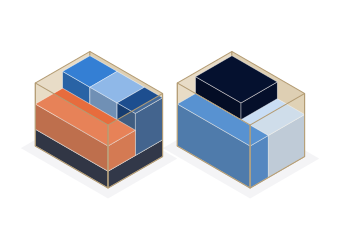
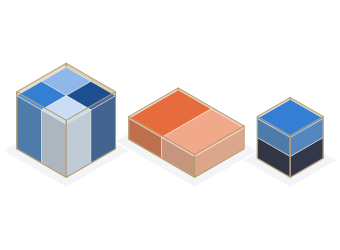
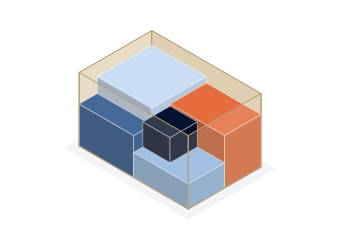
Three ways to pack the same order, from the Pulse 3D cartonization page. The highest fill rate means the least air and void fill. In the illustrative example on that page, it needs three cartons and costs $100, while the lowest-cost plan uses two cartons at 79% fill for $80.
Pulse, the Optioryx optimization layer that runs on top of your WMS, scores every packing option against your carrier rates and the objectives you rank, for example lowest cost first and highest fill rate second. Across customer deployments, Pulse cartonization ships 15 to 30% less air and lowers transport cost by 10 to 30%. It also routes flat items to envelopes, supports adjustable-height boxes, and can analyse historical orders to recommend a better box range.
What it looks like on the floor
Van Moer Logistics packs with seven box types and two types of cardboard envelopes. Its order pickers know in advance which of the seven boxes to take, and can be sure every item will fit. The software also showed that significantly more items could fit into a single box, which cut the number of shipping labels needed. The Van Moer packing case describes the setup.
Voltex runs Pulse for pick-to-box, so each order goes straight into the box Pulse selects. Alex Morton, Distribution Technology Lead at Voltex, reports lower freight cost, lower packaging cost, and lower labour cost from the time saved on repacking. He walks through the setup in this customer video.
Questions?
Void fill is material such as crumpled paper, air pillows, bubble wrap, packing peanuts or cardboard inserts that fills the empty space in a shipping box. It keeps products from moving and hitting each other or the box walls in transit. The more empty space a box has, the more void fill it needs.
Per volume of fill, crumpled kraft paper is usually the cheapest material; a 2026 comparison by Stanley Packaging calls it the most cost-effective option per unit of void fill created. Air pillows add a machine but store compactly as a film roll. A smaller box saves more than a cheaper filler, because it also lowers the dimensional weight the carrier bills.
Subtract the total volume of the items from the internal volume of the carton; the result is the void volume. Two items of 25 x 15 x 10 cm (7.5 litres together) in a 40 x 30 x 20 cm carton (24 litres) leave 16.5 litres to fill. Divide the void volume by the volume of one air pillow or paper pad to estimate how many you need.
Yes. Under the EU Packaging and Packaging Waste Regulation, filling materials such as paper, air cushions, bubble wrap and foam count as empty space. From 1 January 2030 at the earliest, e-commerce, grouped and transport packaging may contain at most 50% empty space, and adding void fill cannot bring a box under the limit. The fix is a smaller box for the same items.
Choose a right-sized box for every order before packing starts, using cartonization software that fits the items in 3D. Add the box sizes your order profile is missing, send flat items in envelopes, and keep accurate item dimensions in the item master. Across customer deployments, Pulse cartonization ships 15 to 30% less air.