


Summary
A split shipment is one customer order that leaves in two or more shipments: separate parcels, pallets or truckloads, each with its own label and often its own delivery date. Split shipments happen when stock sits in more than one place, when a line is out of stock, or when the order does not fit one box or one vehicle. Most unplanned splits add cost. Some planned splits save it, when one large box would be mostly air or cross a carrier size line, and cost-aware cartonization decides that per order.
The share of orders that left the warehouse in more than one parcel last month is often a guess. The number is already in the shipping data, as one order number with several tracking numbers, yet it is rarely broken down by cause. Without the cause, every split looks the same and the fixes get mixed up.
Some causes sit before order release, in where inventory is stocked and how orders are routed. Others sit inside the building: the box range, the moment the box is chosen, and carrier rules nobody at a packing station can calculate by hand. The two groups need different fixes, and one group includes the splits you want to keep.
What is a split shipment?
A split shipment means one order, several shipments. The customer places one order with several order lines, and the shipper sends it as two or more parcels or freight units. The parts can leave the same warehouse on the same day in separate boxes, or leave different warehouses days apart.
The term covers parcel and freight. In parcel shipping, a split is an extra box with its own label and tracking number. One order can also split across modes, with cartons going by parcel carrier and a bulky line on a pallet.
In freight, a split is an order spread over more pallets than planned, or a load that does not fit the booked truck, so part of it goes on a second vehicle or a later departure.
Four terms get mixed up in searches and in order management systems. Every partial shipment is a split shipment, but a split shipment can also happen when every line is in stock. The table puts them side by side.
| Term | What it means | Example |
|---|---|---|
| Split shipment | One order sent as two or more shipments | Three order lines leave in two cartons |
| Partial shipment | Part of the order ships now, the rest later because it is not ready | Two lines ship today, the backordered line next week |
| Split delivery | The customer's view: the order arrives in more than one delivery | Two parcels arrive on Tuesday and Thursday |
| Order splitting | The system decision to divide one order into several fulfillment orders | Order routed to two warehouses |
View this comparison on desktop for the full data table.
Split shipments are either planned or unplanned. A planned split is decided before picking, to make a delivery date from two warehouses or because two boxes cost less than one. An unplanned split happens on the floor: the chosen box turns out too small, a late order line misses the wave, or the pallet count was too low for the booked truck.
Unplanned splits are the ones to remove. Planned splits are a cost decision, made per order.
Why split shipments happen
Most split shipments start in one of two places: where the stock is, or how the order is packed and loaded. The first group is decided by planning and order management. The second is decided in the warehouse, often in the last minutes before the carrier cut-off.
Before release: inventory and order routing
- Stock in several locations. When an order management system routes each line to the warehouse that holds it, items that sell together but are stocked apart turn into two shipments by design.
- Stockouts and backorders. One line is missing at the chosen site, so the rest ships now and the missing line follows as a partial shipment, or it ships from another site.
- Supplier lines and customer choices. Lines shipped directly by a vendor, or sent to more than one address on the customer's request, are separate shipments from the start.
Inside the warehouse: box, timing and carrier limits
- The box range. Most warehouses stock a handful of box sizes. When an order does not fit the largest one, it goes into two, and when it falls in the gap between two sizes, the choice is between one box with a lot of air or two smaller boxes.
- Box chosen at the packing station. The packer judges the order by eye. When the box turns out too small, the leftover items go into a second box, and nobody checks whether a different single box would have held everything.
- Pick timing. Lines picked in different zones or waves reach packing at different times. If part of the order is still on its way at cut-off, the part that is there ships alone.
- Carrier limits. Every parcel carrier caps the weight and size of a single package and charges extra above certain thresholds, so a heavy or long order gets split to stay inside the rules.
Freight orders split for the same reasons at a larger scale. The order needs more loading meters or more weight than the booked truck carries, the axle limits do not allow the plan, or the pallet count was estimated instead of calculated. 3D truck load building shows how the load fits before the truck arrives.
What split shipments cost, and how to measure yours
Every extra parcel pays its own base rate, its own label and its own handling. Carriers bill each package separately, on its own billable weight, and per-package surcharges apply to each one again. The second box also needs packing material, a scan at the dock and a place in the outbound flow.
The cost per split adds up at volume. Per-parcel fees come back with every extra box: in UPS rates from 22 December 2025, a Ground parcel to a home address carries a $6.50 residential surcharge, plus $6.55 where a delivery area surcharge applies. A 2024 study on order consolidation found that consolidating orders instead of splitting them cut average cost by 30.25% in its simulated test scenarios.
Some costs do not show on the carrier invoice. A customer who receives half an order often calls or emails to ask where the rest is, and a second parcel means more cardboard and another delivery stop. In freight, a split usually means a second truck that leaves partly empty.
How to find your split rate
Your shipping data already holds the answer. A split rate is only useful once it is sorted by cause, because each cause has a different owner.
- Export one month of shipments with order number, tracking number, origin warehouse, ship date and box type.
- Count the orders with more than one tracking number, and divide by the number of multi-line orders. That is your split rate.
- Tag each split. Different origin warehouses point to inventory placement. The same warehouse on different days points to stock availability or pick timing. The same warehouse on the same day points to packing.
- For the same-day packing splits, check whether the order would have fit one box in your range, and what each option would have cost at your carrier rates.
The same-day, same-warehouse splits are the ones a packing decision can change, in both directions: some should have been one box, and some single boxes should have been two.
When two boxes cost less than one
Fewer cartons does not always mean a lower freight bill. Parcel carriers bill each package on the higher of its actual weight and its dimensional weight, and they add surcharges when a package crosses size or weight thresholds. A single large box can therefore cost more than two smaller ones.
UPS sets out the rules on its shipping dimensions and weight page. Dimensional weight is length x width x height divided by a divisor of 139 for daily rates, with each measurement rounded up to the next whole number. A single package can weigh up to 150 lbs, be up to 108 inches long, and measure up to 165 inches in length and girth combined.
Below those limits sit the surcharge lines, set out on the UPS page on how to avoid extra shipping fees. UPS applies Additional Handling when the longest side exceeds 48 inches, the second-longest side exceeds 30 inches, or a domestic package is larger than 10,368 cubic inches. UPS added the cubic line on 26 January 2026.
The Large Package Surcharge applies when length plus girth exceeds 130 inches, when the length exceeds 96 inches, or when a domestic package is larger than 17,280 cubic inches or heavier than 110 lbs, and such a package bills at least 90 lbs. In UPS rates from 22 December 2025, Additional Handling for size costs $30.00 in zone 2 and the Large Package Surcharge $219.50 to a commercial address in zone 2. Our carrier oversize fees playbook lists the size and weight lines behind each fee and how to stay under them.
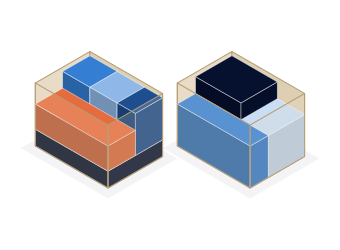
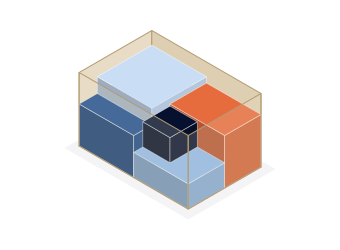
The gap between box sizes is where a planned split pays. Take an order of three items, 22 lbs in total, that does not fit the 16 x 12 x 12 or the 18 x 12 x 10 box on its own, so the next size up is a 24 x 18 x 16. Packed in two smaller boxes instead, it ships as two parcels with far less air.
| Option | Boxes (inches) | Volume (cubic inches) | Dimensional weight (lb) | Actual weight (lb) | Billable weight (lb) |
|---|---|---|---|---|---|
| One box | 24 x 18 x 16 | 6,912 | 49.7 | 22 | 50 |
| Two boxes | 16 x 12 x 12 and 18 x 12 x 10 | 2,304 + 2,160 = 4,464 | 16.6 + 15.5 = 32.1 | 12 + 10 = 22 | 17 + 16 = 33 |
| Difference | One extra parcel and label | -2,448 | -17.6 | 0 | -17 (34% less) |
Illustrative example. Dimensional weight = length x width x height / 139 (UPS daily rates). Billable weight is the higher of actual and dimensional weight per package, rounded up to the next whole pound.
View this comparison on desktop for the full data table.
The two boxes bill 17 lbs less in total, 34% less than the single box. Whether the split pays depends on the rate card, because the second parcel adds a base rate and a label. At a high price per pound, in a far zone, the two boxes win. At a high minimum charge per package, in a near zone, the single box can still be cheaper.
That answer changes per order, per destination and per carrier contract. A packer cannot run this calculation for every order at the packing station, so the default is one box, picked one size up to be safe.

Carrier choice adds a second layer: the cheapest way to pack for one carrier is not always the cheapest for another. How you pack decides which carrier you should use works through that trade-off, and cost-optimal packing can be counterintuitive shows more cases where an extra box lowers the bill.
How to reduce split shipments
Each cause in the shipping data has its own fix. Splits from inventory placement will not drop because the packing station changes, and packing splits will not drop because stock moves between sites.
Stock items that sell together in the same place
Check which SKUs appear on the same orders and keep them in the same warehouse, at least for your fastest movers. A network that stocks every SKU everywhere splits less but carries more inventory, so a common compromise is the core range in every warehouse and the long tail in one.
Route and release orders as a whole
Send the whole order to one site that can fill every line within the delivery promise, and allow a split only when waiting would break the promise. The same rule works inside one building: release an order to packing only when all its lines are picked, unless the cut-off is close.
Decide the box count before picking
The box decision moves from the packing station to order release. With cartonization, the system knows the items, their dimensions and the box range, and it decides before picking whether the order ships as one box or two. In pick-to-box, the picker takes the right boxes on the trolley and picks straight into them, so nothing gets repacked or split at the end.

Van Moer Logistics described the problem before it used Pulse: its pickers did not know in advance how many items would fit in a box, so the team requested more shipping labels from the carrier than it needed.
Now the pickers know before they start which of the seven box types to take, and more items fit in one box. The Van Moer packing case describes the setup.
Voltex runs Pulse for pick-to-box, with the box type assigned at order release. Alex Morton, Distribution Technology Lead at Voltex, reports reduced freight, packaging and labor cost, from the time no longer lost on repacking. The customer video shows the flow.
Get item dimensions right first
A box decision is only as good as the item dimensions behind it. If the item master says a product is smaller than it is, the planned box is too small and the packer splits the order anyway. Why item dimensions matter covers the other processes that depend on the same data.
Flux, the Optioryx mobile data platform, measures item dimensions with a LiDAR iPhone 13 Pro or newer, or an iPad Pro 2020 or newer, and shares them with your systems by export or API. The Flux product sheet lists the workflows.
Plan freight before the truck arrives
Calculate the pallet count and the load plan when the order is entered, then book the truck space it needs. Truck load planning explains how to book FTL or LTL space from each order's pallet count and fill rate. When a truck still has spare space, the customer can add products to the order for the same transport cost.
How cartonization software decides one box or two
Pulse scores every packing option for an order against the carrier rates you load in: weight bands, dimensional divisors, parcel-count rules and size limits, all at the same time. The result is the number of boxes, which boxes, and a placement plan for each.
You rank the objectives yourself. Lowest shipping cost first and highest fill rate second, or fewest cartons first when one label and one handling unit matter more, for example for a customer who refuses split deliveries. Rules for stacking, rotation, fragile items and orientation apply in every option.
Pulse runs on top of your WMS or ERP and is called where the box decision belongs. At order entry it predicts the parcel and pallet count, so the shipping quote and the split decision exist before anything is picked. At release it drives pick-to-box, and at the packing station it shows the packer a 2D or 3D packing plan.
Across customer deployments, Pulse lowers transport cost by 10 to 30%. The same order history also shows which box sizes are missing from your range, the gap that forces many orders into one box too big or two boxes too many.
The 3D cartonization product sheet summarizes the packing features on one page. For the other tools that cut shipping spend, from cartonization to load planning, see warehouse tools that reduce transport cost, and for the measurable gains of right-size packing, the benefits of cartonization.
Questions?
A split shipment is any order sent as two or more shipments, even when every line is in stock. A partial shipment is one kind of split: part of the order ships now and the rest follows later because it is not ready, usually a backorder. Every partial shipment is a split shipment, but not every split shipment is partial.
Split shipments happen when items in one order are stocked in different warehouses, when a line is out of stock, or when the order does not fit one box or one truck. Inside the warehouse they also come from a limited box range, lines that reach packing at different times, and carrier size and weight limits per package.
Usually, yes. Each extra parcel pays its own base rate, label, packing material and handling, and a partial delivery often triggers a customer contact. In UPS rates from 22 December 2025, every Ground parcel to a home address also carries a $6.50 residential surcharge. The exception is a planned split that avoids a large, mostly empty box or a carrier surcharge.
First measure the split rate and tag each split by cause. Then stock items that sell together in the same place, route orders as a whole to one site, release orders to packing only when all lines are picked, and decide the box count at order release with cartonization software instead of at the packing station.
Two boxes are cheaper when one box would carry a lot of air or cross a carrier threshold, such as a UPS Additional Handling line at 48 inches on the longest side or 10,368 cubic inches. Carriers bill each parcel on the higher of actual and dimensional weight, so two well-filled boxes can bill less weight than one large box. The second base rate decides whether the saving holds.