


What Is Dimensioning in Warehousing?
Warehouse dimensioning is the process of capturing the length, width, height, and weight of parcels, cartons, and pallets. These measurements feed carrier billing, slotting decisions, pallet stacking algorithms, and master data management.
When dimensions are missing or wrong, warehouses typically (1) overpay on freight because carriers bill by dimensional weight, (2) waste cube on pallets and in cartons, and (3) mis-slot products, which increases travel and handling.
There are 3 ways to gather measurements.
- Manual measuring (tape measure). Accurate when done carefully for cuboids, but slow and inconsistent at scale.
- Static dimensioners (fixed hardware). For the last ~20 years, many warehouses have relied on static systems (e.g., Cubiscan-style setups). You place each parcel on a fixed station and capture the data. It is tied to one location, requires process changes to funnel items through it, and comes with high upfront cost and limited flexibility.
- Mobile dimensioning (software on phones/tablets). Mobile dimensioning apps capture the same measurements wherever the work happens: at inbound, in storage aisles, at pack stations, or on oversized items that never touch a conveyor. For many operations, the draw is cost, speed of rollout, and the ability to dimension SKUs and pallets without changing material flow.
Read the comparison of the 3 dimensioning methods.
How Static Hardware Dimensioners Work
Static dimensioners like Cubiscan, vMeasure, and FreightSnap use infrared curtains, structured light sensors, or camera arrays mounted on a fixed frame.
A parcel passes through or sits on the platform. The system captures dimensions in 1–3 seconds with +/- 0.5 - 1 cm accuracy on cuboidal objects.
The hardware costs $20,000–80,000 per unit depending on the size range and throughput rating. Installation takes 2–4 weeks. Calibration is required monthly. And every unit covers exactly one point in the warehouse.
A Cubiscan 100 handles items up to 60x50x40cm. Need to measure pallets? That takes a pallet-scale unit such as the Cubiscan 1200, plus a fork truck or pallet jack to get the load onto the platform. Cubiscan does not publish list prices, so the budget comes from a quote rather than a number you can look up.
Want dimensioning at inbound, outbound, and returns? Three separate units. Three separate investments.
How Mobile Dimensioning Software Works
Mobile dimensioning software uses the LiDAR sensor and camera built into modern smartphones and tablets to capture 3D measurements. The operator points the device at a parcel or pallet, the app guides them through a 3–5 second scan, and dimensions are captured automatically.
No bolting. No conveyor integration. No calibration schedule. The device goes wherever the operator goes: inbound dock, packing station, returns desk, or client site. Supported devices include iPhone 13 Pro and later and iPad Pro 2020 and later.
Accuracy for parcels (up to 120cm) reaches +/- 1–2cm. For pallets, +/- 2–3cm — less precise than static hardware's +/- 5mm, but sufficient for the two biggest use cases: carrier billing (where DIM weight tiers are 1kg increments) and slotting (where a 2cm variance does not change slot assignments).
Static Hardware vs Mobile Software Comparison
Static dimensioners win at high-volume, single-point inline measurement — if you process 10,000+ parcels per day through a single conveyor line, static hardware is faster.
But most warehouses don't have all dimensioning needs in one spot. They need measurements at receiving, quality checks, returns, and outbound. That is where mobile wins.
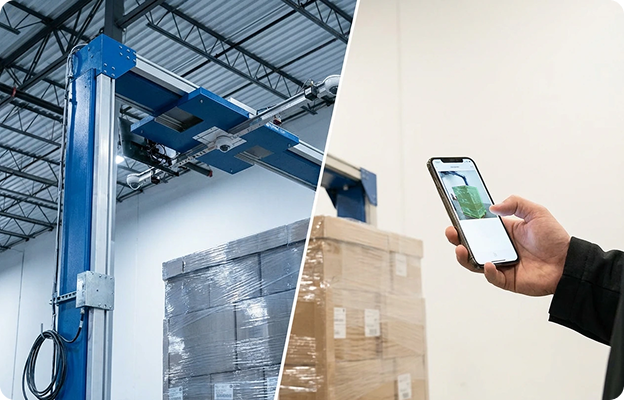
When to Choose Static Hardware
Static hardware makes sense when three conditions are met simultaneously:
1. Single-point throughput exceeds 800 items/hour. The conveyor belt is the bottleneck, not the dimensioner.
2. Sub-centimeter accuracy is legally required. Certified trade programs mandate +/- 5mm for legal-for-trade billing.
3. Budget exceeds $50K for dimensioning. You can afford the hardware plus maintenance, calibration, and IT integration.
If all three are true, buy static hardware. If even one is false, mobile dimensioning is likely the better fit.
When to Choose Mobile Dimensioning Software
Mobile dimensioning is the better choice when you need flexibility, speed, lower cost, or richer data capture.
- Flexibility. Measurements at multiple locations — dock door, returns desk, QA station, client site — with one device covering all of them.
- Speed to deploy. Download the app, scan a test parcel, go live. No installation crew, no conveyor modifications, no IT project.
- Lower total cost. A warehouse with 5 measurement points needs $75,000–400,000 in static hardware. Mobile dimensioning covers the same 5 points for under $5,000 in devices plus a monthly subscription.
- Extra data capture. Mobile apps do more than measure. Flux captures dimensions, photos, barcode scans, label recognition, and damage documentation in a single workflow — feeding master data, compliance records, and claims processes. A static dimensioner captures dimensions and weight only.
The accuracy gap (+/- 5mm vs +/- 1–2cm) rarely matters in practice.
Carrier DIM weight tiers jump in 0.5–1kg increments. A 2cm measurement variance on a 40x30x20cm box changes the DIM weight by less than 0.3kg — within the same billing tier 95%+ of the time.
Where accuracy does matter: certified legal-for-trade billing and pharmaceutical packaging with tight tolerance requirements.
Measure Smarter with Flux
Many warehouses land on a hybrid setup: one static dimensioner on the high-volume outbound conveyor line, mobile dimensioning everywhere else.
This gives you inline speed where throughput demands it and flexibility where it does not. Flux supports this hybrid model — integrating with static dimensioners for inline data while providing mobile capture at all other points.
One data pipeline, one master data set, regardless of the measurement source.
Questions?
Modern LiDAR-equipped phones achieve +/- 1–2cm accuracy on parcels and +/- 2–3cm on pallets. This is sufficient for carrier DIM weight billing — tiers jump in 0.5–1kg increments, meaning a 2cm variance changes the billed weight by less than 0.3kg in most cases — and for warehouse slotting, where slot categories span 10–15cm ranges. Phone-based accuracy is not sufficient for certified legal-for-trade requirements (NTEP in the US, MID in Europe), which mandate +/- 5mm. For standard warehouse workflows including receiving, returns, and slotting, phone-based dimensioning is more than adequate.
Cubiscan systems range from $15,000 for a basic parcel unit (Cubiscan 100) to $80,000+ for pallet-capable systems (Cubiscan 325). Add $2,000–5,000 per year for maintenance and calibration, plus $5,000–15,000 for installation and WMS integration. The total cost of ownership over three years typically lands between $30,000 and $120,000 per unit depending on the model and integration complexity. Warehouses needing dimensioning at multiple points — inbound, outbound, and returns — require separate units at each location.
Yes. Phones with LiDAR sensors — iPhone 13 Pro and later, iPad Pro 2020 and later — can measure pallet dimensions with +/- 2–3cm accuracy. The scan takes 5–10 seconds. This accuracy is sufficient for freight billing, inventory management, and load planning. For certified legal-for-trade pallet measurements required by some carrier contracts or regulatory programs, a certified static dimensioner remains the required solution.
Most carriers accept mobile dimensions for rate shopping, cost estimation, and standard freight billing. For certified legal-for-trade billing — where the shipper and carrier have a formal DIM weight agreement requiring NTEP or MID certification — some carriers require certified static measurements. Check your carrier contract for specific requirements. For the majority of warehouse operations, mobile dimensions are accepted and routinely used for carrier billing without issue.
A single parcel scan takes 3–5 seconds. Including barcode scanning and photo capture, a complete inbound check takes 10–15 seconds per item. Experienced operators process 200–300 items per hour using mobile dimensioning. For comparison, a static inline dimensioner processes 400–1,200 items per hour but covers only one fixed point in the warehouse. Mobile dimensioning is the faster solution when measurements are needed at multiple warehouse locations rather than a single high-volume conveyor line.
For returns processing, mobile dimensioning is ideal. Accuracy requirements are lower — you need approximate dimensions for restocking decisions, not certified billing — and the ability to capture photos and damage documentation alongside measurements makes mobile the preferred tool. Mobile dimensioning also handles irregular and damaged shapes better than static portal frames, which are optimised for cuboidal parcels. For high-volume returns operations, mobile capture provides both the flexibility and the additional data capture that static hardware cannot match.
Yes, to capture accurate measurements of items you do require to have a compatible device. Compatible devices include: iPad Pro (2020+) or iPhone 13 Pro+
Flux includes mobile dimensioning through the device camera, which can replace or supplement traditional dimensioning hardware in many inbound, outbound and claims workflows. It is especially useful for distributed or multi-site operations.