


Summary
The best palletization software depends on whether you need pallet building for manual operators, robotic cells, or a combination - and how tightly you want it connected to picking and cartonization. This article focuses on optimization software - the intelligence layer that calculates how pallets should be built.
That same optimization can guide a human operator through step-by-step stacking instructions or feed placement coordinates to a robotic arm.
The distinction matters: hardware alone doesn't solve mixed-case palletization. The algorithm does.
Why Palletization Software Matters
Pallet stacking decisions affect more than just the dock. When pallets are built without a plan, warehouses deal with unstable loads, wasted cube space on trailers, inaccurate pallet count estimates during order capture, and staging areas that overflow because outbound volume wasn't pre-calculated.
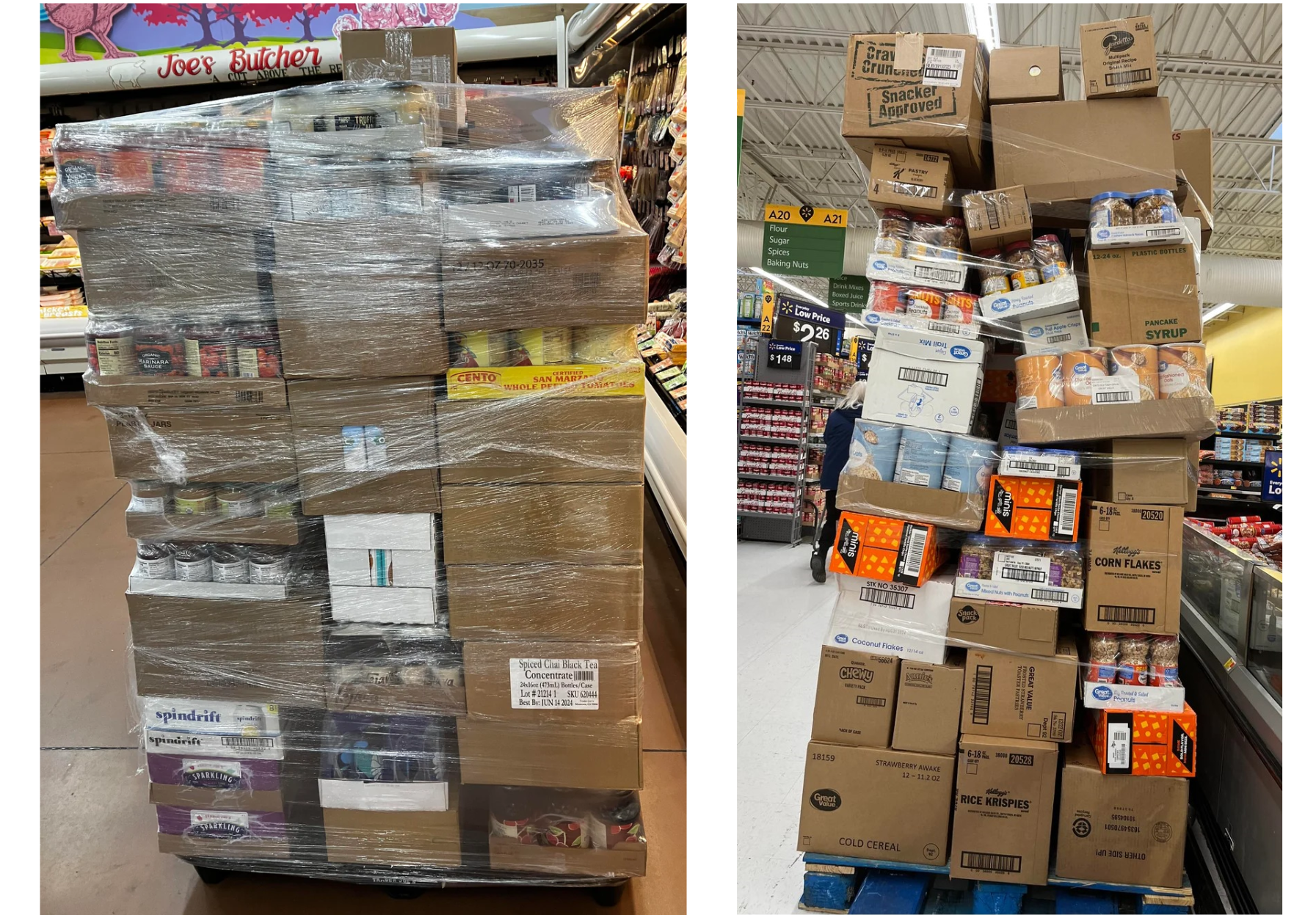
Poor pallet building leads to 15-25% wasted trailer cube utilization, and manual stacking without guidance produces inconsistent load heights that create damage in transit.↑
For operations shipping mixed-case pallets - where different SKUs, weights, and dimensions share the same pallet - the problem compounds.
Without software, operators either stack conservatively (wasting space) or aggressively (risking damage).
Modern palletization software solves this by generating optimized pallet build plans before picking starts.
The best tools account for:
- product weight and crushability,
- stacking compatibility,
- pallet height and weight limits,
- and compliance constraints like temperature zones or flammable goods separation.
Some go further and integrate pallet planning with picking sequences, so the pick order already reflects the bottom-up stacking sequence.
There's a human factor too.
When operators build pallets without guidance, the outcome depends entirely on individual experience and judgment - leading to inconsistent results across shifts, teams, and sites.
Software-guided stacking removes that variability: every operator follows the same optimized plan, which means consistent pallet quality regardless of who's on the floor.
It also protects workers - heavy items are placed at the bottom by design, fragile goods are never crushed under weight, and pallet height stays within safe limits. The result is less product damage in transit.
The barrier to entry is lower than most operations expect. System-guided palletization - where software calculates the optimal stacking plan and operators follow step-by-step instructions - requires very little capital investment. There's no hardware to procure, no conveyors to install, and no robotic cells to commission.
A warehouse can pilot software-guided palletization on a single outbound lane, validate the results on real orders, and scale from there.
This makes it the fastest path from unplanned pallet builds to optimized ones.
For operations that need to quote pallet counts and transport costs at order capture, the impact is direct: accurate pallet count estimation eliminates the guesswork that leads to wrong carrier bookings and surprise freight charges.
Palletization Software Comparison
The table below compares four tools across mixed-case pallet support, operator guidance, integration requirements, and target use cases.
- Pulse (Optioryx) is a dedicated warehouse optimization platform powered by digital twin technology and AI algorithms. It handles mixed-case palletization alongside picking and cartonization in a single engine - meaning pallet build plans already account for pick sequences and box selection. Operators get simple 2D step-by-step stacking instructions or full 3D visualization.
No WMS integration required to start: upload order data, run a pallet simulation, and validate results in days. Deploys on top of any existing WMS once proven.
- TOPS Pro (TOPS Engineering) is a veteran pallet pattern design tool with over 30 years on the market. It calculates optimal stacking patterns using compression analysis and the McKee formula, and is widely used by packaging engineers for pallet pattern optimization.
The trade-off: it's a desktop application designed for pattern design, not live warehouse operations. Generating pallet plans for individual orders at pick time is not its primary use case.
- Cube-IQ / BlackBox (MagicLogic) is an enterprise-grade 3D load planning engine. It handles palletization alongside container and truck loading, with strong API integration for WMS/TMS systems. It supports mixed-case palletization with crush resistance and weight distribution rules.
The limitation: it's a general-purpose load optimization tool, not purpose-built for warehouse pallet building. Configuration and tuning typically require technical resources or MagicLogic's professional services.
- Jacobi Robotics is focused specifically on robotic mixed-case palletization. Its AI-driven motion planning software controls industrial robots for autonomous pallet building.
It requires physical robotic hardware - it's a robotics solution, not a software tool for manual or semi-manual warehouses.
Vendor Profile Deep Dive
Pulse (Optioryx)
Pulse is a warehouse optimization platform that handles palletization alongside picking and cartonization in a single engine. Rather than treating pallet building as an isolated step, Pulse connects it to picking sequences and box selection - so the order in which items are picked already reflects the bottom-up stacking sequence of the pallet.
Under the hood, Pulse uses AI-powered algorithms with highly configurable stacking rules: layer-based stacking, tower-based stacking, multiple item heights in the same layer, and the ability to spread SKUs across multiple pallets when a single pallet can't hold the full order.
Operators receive step-by-step stacking instructions in 2D (simple placement guides) or 3D (full visual model). The webapp lets you run pallet simulations and manually adjust 3D results before committing - the user stays in control of the final build plan.
Pallet count at order capture: Pulse calculates the exact number of pallets for a given order in real time, via the webapp or API. This directly solves the problem of quoting transport costs up-front and communicating accurate pallet counts to carriers.
What makes it different: Pulse is a self-service webapp. Upload your order data, run a palletization simulation, and validate the stacking plans without any WMS integration. Once proven, API integration connects Pulse to your live WMS for ongoing pallet planning. No integration required to start.
Ideal for: Outbound operations that need accurate pallet counts at sales-order capture, manual and semi-manual warehouses with pick-to-pallet workflows, and any team dealing with overflowing staging areas caused by unplanned pallet builds.
Limitation: Requires structured order data (SKU dimensions, weights, order lines) as input. Not all WMS systems export this cleanly on the first attempt.
TOPS Pro
TOPS Pro has been on the market for over 30 years, primarily as a pallet pattern design tool for packaging engineers. It calculates stacking patterns for specific product configurations during packaging design, not during live order fulfillment.
Strengths: Compression analysis using the McKee formula to estimate how much weight a case can bear in a stack. Supports mixed-case palletization with interlocking patterns. 3D visualization for previewing pallet builds. Used in CPG and manufacturing for standardizing pallet configurations.
Limitation: TOPS Pro is a desktop application designed for pattern design and packaging engineering. It calculates how to stack a known set of case sizes on a pallet — but it's not designed to generate live pallet build plans for individual warehouse orders at pick time. There's no native pick-to-pallet support, no operator-facing stacking instructions during fulfillment, and no webapp or self-service mode. Connecting it to a live WMS requires custom development through the optional web-API.
Best for: Packaging engineers who need to design and standardize pallet patterns offline, before products reach the warehouse floor.
Cube-IQ / BlackBox (MagicLogic)
MagicLogic's Cube-IQ (also known as BlackBox in its server-based form) is a 3D load optimization engine. It handles palletization alongside truck loading and container filling — making it a broader logistics optimization tool rather than a purpose-built palletization solution.
Strengths: Mixed-case palletization with crush resistance rules, weight distribution, and stacking constraints. API integration options for WMS and TMS systems (SOAP, REST, TCP). Supports cloud (Azure) and on-premise deployment. Used by some large 3PLs and automotive operations.
Limitation: Cube-IQ is a general-purpose load optimization engine. Configuration and tuning for specific warehouse palletization workflows typically require technical resources or MagicLogic's professional services team. The 3D visualization exists but doesn't extend to operator-facing stacking instructions on the warehouse floor without custom middleware. No self-service webapp for running palletization simulations — testing requires integration or a sales engagement. Implementation complexity is higher than purpose-built palletization tools.
Best for: Enterprise logistics operations that need palletization combined with truck and container load optimization, particularly 3PLs managing multi-modal freight.
Jacobi Robotics
Jacobi Robotics is a robotics software company that focuses on robotic mixed-case palletization. Its motion planning software controls industrial robots for autonomous pallet building, scanning items, calculating placement, and directing the robot arm through collision-free paths.
Strengths: Motion planning that handles mixed-case pallets autonomously. Configurable stacking rules for weight limits, fragility, and product compatibility. Claims rapid robot deployment, days rather than weeks for new SKU onboarding.
Limitation: Jacobi requires physical robotic hardware, industrial robot arms, vision systems, and conveyors. It's a robotics solution, not a software tool for manual or semi-manual warehouses. If your operation relies on human pickers building pallets, Jacobi doesn't apply. Pallet count estimation at order capture is not a feature - the system plans pallets for items that arrive at the robotic cell.
Reality check on robotic palletization: Fully automated mixed-case palletization remains one of the hardest problems in warehouse robotics. Uniform-case palletizing (identical boxes) is well-established, but mixed-case - where every pallet contains different dimensions, weights, and fragility levels - pushes current robotic systems to their limits. The capital investment is significant (robotic cells, vision systems, conveyors, safety infrastructure), making this a viable path primarily for the largest, highest-volume operations. For the majority of warehouses, software-guided palletization delivers the optimization gains without the hardware commitment.
Best for: Automated or automating warehouses with existing or planned robotic cells, where the goal is to replace manual pallet building entirely.
Feature Comparison
Mixed-Case Palletization
All four tools support mixed-case palletization, but the approaches differ significantly.
Pulse offers the most configurable stacking logic for live warehouse operations - layer-based stacking, tower-based stacking, and mixed-height layers with automatic SKU spreading across pallets.
TOPS Pro handles mixed-case through interlocking pattern design with compression analysis, but this is calculated offline for packaging standardization.
Cube-IQ applies crush resistance and weight distribution rules as part of its broader load optimization engine. Jacobi uses AI to calculate robotic stacking sequences for mixed-case pallets arriving at the cell.
Operator Guidance
Pulse is the only tool that generates step-by-step stacking instructions directly for warehouse operators - available as simple 2D placement guides or full 3D visualization. The webapp allows manual adjustment of results before execution, keeping the operator in control. TOPS Pro provides 3D previews for pattern design but these are intended for packaging engineers, not floor operators building pallets at pick time.
Cube-IQ has 3D visualization in its planning interface but needs custom middleware to deliver instructions to operators. Jacobi bypasses the problem entirely - the robot executes the plan autonomously.
Pallet Count Estimation
Accurate pallet count at order capture is critical for operations that need to quote transport costs and book carriers in advance. Pulse provides real-time pallet count calculation via webapp or API - enter the order, get the exact pallet count instantly.
Cube-IQ supports pallet count calculation through its API. TOPS Pro provides pattern-based estimates but isn't designed for order-level pallet counting in real time. Jacobi doesn't offer order-capture estimation.
Pick-to-Pallet Integration
Pulse natively connects palletization to picking: the pick sequence is generated to match the bottom-up stacking order, so items arrive at the pallet in the right sequence for optimal building. This eliminates the buffer step between picking and palletizing.
Cube-IQ can feed pick sequencing through WMS integration, but this requires middleware development. TOPS Pro and Jacobi don't support pick-to-pallet workflows - TOPS Pro is an offline design tool, and Jacobi palletizes after picking is complete.
Pallet Re-Optimization
When inventory is short - items out of stock, quantities reduced, or last-minute order changes - Pulse re-optimizes the pallet plan automatically. The stacking plan adjusts to the items actually available rather than leaving gaps or requiring manual re-planning.
Cube-IQ handles some recalculation but with less flexibility. TOPS Pro generates static patterns and doesn't handle real-time changes. Jacobi can recalculate within its robotic cell but only for items physically present.
Compliance and Stacking Rules
Pulse supports compliance zone constraints including flammable goods separation, temperature zone restrictions, and chemical product segregation within pallet builds. TOPS Pro's McKee formula compression analysis is the most rigorous for crushability - it calculates exactly how much weight each case can bear.
Cube-IQ applies weight distribution and crush resistance rules. Jacobi supports configurable weight and fragility rules within its robotic planning.
How to Choose Your Palletization Software
Step 1: Define your primary use case
Are you building pallets manually on the warehouse floor, or are you automating with robotics?
If manual or semi-manual, Pulse and TOPS Pro are your relevant options - though they serve different stages (live fulfillment vs. offline pattern design).
If robotic, Jacobi is purpose-built. If you need palletization as part of a broader logistics optimization strategy (truck + container + pallet), Cube-IQ covers the full stack.
Step 2: Decide whether pallet count estimation matters
If your operation needs to quote pallet counts and transport costs during sales-order capture, this is a hard requirement. Pulse and Cube-IQ support it. TOPS Pro and Jacobi don't, or only in limited form. If accurate pre-shipment pallet counts drive your carrier communication and freight budgeting, this narrows the field immediately.
Step 3: Assess how palletization connects to picking
Isolated palletization software plans the pallet but doesn't influence how items are picked.
If your pickers build pallets at the end of the pick route - a common workflow in manual warehouses - then pick-to-pallet integration matters.
Pulse is the only tool that natively sequences picks to match the pallet stacking order. If palletization happens post-pick (e.g., at a robotic cell or a dedicated packing station), this is less important.
Step 4: Match implementation effort to your timeline
Self-service webapp (Pulse): run simulations in days, no integration required.
Desktop software (TOPS Pro): install and configure, primarily for offline pattern design.
Enterprise API integration (Cube-IQ): weeks to months depending on WMS/TMS complexity.
Robotic deployment (Jacobi): hardware procurement, installation, and commissioning - typically months.
Step 5: Test with your actual order data
Any palletization tool should prove itself on your specific SKU mix, order profiles, and pallet constraints before you commit.
Pulse lets you upload data and run simulations without integration.
If a vendor can't show you results on your own data, the risk of misaligned expectations is higher.
Making Your Decision
Palletization is one of the last steps in outbound fulfillment - but it cascades backward. When pallet builds are planned before picking starts, pick sequences improve, staging areas clear faster, pallet counts are accurate for carrier booking, and freight costs drop. When they're not planned, every downstream step absorbs the inefficiency.
If you want a dedicated tool with fast time-to-value and no integration overhead to start testing, Pulse (Optioryx) is the lowest-friction option. Upload your order data, run a palletization simulation on 3D digital twin models, and see accurate pallet counts and stacking plans in days.
It's also the only tool here that connects palletization to picking sequences and cartonization, so improvements compound across the operation.
Questions?
Mixed-case palletization means building a pallet with multiple different products — varying sizes, weights, and fragility levels. Unlike single-SKU pallets where every case is identical and stacking patterns are simple, mixed-case requires the software to calculate placement order, weight distribution, crush risk, and height constraints for every unique combination. The number of possible configurations grows exponentially with the number of distinct SKUs on a pallet, which is why manual planning breaks down at scale.
Some tools can. Pulse (Optioryx) and Cube-IQ (MagicLogic) both provide pallet count estimation via API or webapp, meaning you get an accurate pallet count during order capture — before a single item is picked. This is critical for operations that need to quote transport costs to customers or communicate pallet counts to carriers in advance.
Not necessarily. Pulse works as a standalone webapp where you upload order data and get pallet plans without any WMS integration — useful for testing and for operations that don't want to modify their WMS. For ongoing automated pallet planning in a live warehouse, WMS integration improves the workflow, but it is not a prerequisite with every tool.
Palletization is the process of stacking products on a pallet to make them easier and safer to move, store, and ship.
3D palletization software calculates the best way to stack items on a pallet by considering size, weight, and stability. It helps reduce damage and make better use of space.
Single-item palletization uses only one type of product on a pallet, while mixed-case combines different products on the same pallet for delivery.