


Summary
Truck weight distribution is how a load's weight splits across the axles, and every axle has a legal limit of its own on top of the gross weight limit. The split depends on where the load's centre of gravity sits between the axles. To calculate axle weight, multiply the load weight by the distance from the front support to the load's centre of gravity, divide by the wheelbase, and add each axle's empty weight. In EU international traffic a five-axle articulated truck may weigh 40 tonnes, with at most 11.5 tonnes on the driving axle. On the US Interstate the limits are 80,000 pounds gross, 20,000 pounds per single axle and 34,000 pounds per tandem.
A truck can be under its gross weight limit and still be overloaded. The same 25 tonnes of pallets on a 40-tonne combination can pass or fail at the weighbridge depending only on where the heavy pallets stand. Spread them evenly and every axle is legal. Put them in the front rows and the drive axle is three tonnes over.
For a warehouse, that split is decided at the loading dock, long before the driver reaches a weighbridge. The team that builds the load needs each pallet's weight before it decides where the pallet goes. Truck load planning decides how much truck space an order needs and which truck to book. Weight distribution decides where each pallet goes inside it.
What is axle weight distribution?
Axle weight is the weight that one axle, or one group of axles, puts on the road. The California commercial driver handbook defines it as "the weight transmitted to the ground by 1 axle or one set of axles" (California DMV). Gross vehicle weight is the whole vehicle with its load. Gross combination weight is a tractor and trailer together, load included.
Axle weight distribution is how the total weight splits between the axles. On a tractor with a semi-trailer there are three groups to watch: the steer axle under the cab, the drive axle or axles behind it, and the axle group at the back of the trailer. The front of the trailer rests on the tractor's fifth wheel through the kingpin, so part of the cargo weight goes to the tractor's axles and the rest to the trailer's.
Each group has its own legal limit, and the limits add up to more than the gross limit. Under EU rules a two-axle tractor with a tri-axle trailer has 10 + 11.5 + 24 = 45.5 tonnes of axle limits, but the combination may only weigh 40 tonnes. That 24 tonnes on the trailer applies when its axles are more than 1.3 m and up to 1.4 m apart. A load has to stay under the total and under every axle limit at the same time.
Weight is distributed in three directions. Front to back decides the axle split, side to side decides how evenly the left and right wheels carry it, and height decides how high the centre of gravity sits. The same handbook is direct about height: "A high center of gravity (cargo piled up high or heavy cargo on top) means you are more likely to tip over." Front to back is the direction the law measures axle by axle, and the one a loading plan has to calculate.
Why does truck weight distribution matter?
Weight in the wrong place changes how a truck steers. The California handbook puts it plainly: "Too much weight on the steering axle can cause hard steering." Too little weight is a problem as well: "Under-loaded front axles (caused by shifting weight too far to the rear) can make the steering axle weight too light to steer safely."
The drive axle needs weight for grip. EU rules require at least 25% of a combination's laden weight on the driving axle or axles in international traffic (Directive 96/53/EC, Annex I). A rear-heavy load can break that rule while every axle is under its own limit.
In the UK, the DVSA can stop an overloaded vehicle from moving "until some of the load has been moved or removed", and anyone using an overloaded vehicle can be prosecuted (GOV.UK, HGV overloading). The same guidance says the operator shares the legal responsibility with the driver. For the shipper, a prohibited truck means a late delivery and a load that has to be rebuilt away from the warehouse.
Multi-drop routes change the distribution during the trip. Every drop takes weight off one part of the trailer, so a load that was legal at the dock can overload an axle after the first stop. GOV.UK tells drivers to "redistribute your load appropriately after any drop-offs to avoid overloading axles". Loading the first drop at the doors and the last drop at the front keeps the unloading order right, and it also decides which axles get lighter first.
Running light has a cost too. Axle capacity left unused on every trip is truck space you pay for and do not fill, which is why planning a truckload starts by working out what each order needs before the truck is booked.
What are the legal axle weight limits in the EU and US?
In the EU, Directive 96/53/EC sets the maximum weights for trucks in international traffic. Its consolidated text on EUR-Lex allows 40 tonnes for a five- or six-axle articulated vehicle. A three-axle tractor with a two- or three-axle semi-trailer carrying containers or swap bodies of up to 45 feet in intermodal transport may weigh 44 tonnes.
Per axle, the directive allows 10 tonnes on a single non-driving axle, such as a steer axle, and 11.5 tonnes on a driving axle. Trailer axle groups get a limit that depends on the spacing between the axles: from 11 to 20 tonnes for a tandem and from 21 to 24 tonnes for a tri-axle. The directive covers traffic between member states, so check national rules for domestic trips.
The directive is under revision. The European Commission proposed changes on 11 July 2023, mainly to give zero-emission trucks more weight, and the EU procedure page listed no adopted act in October 2026. The figures below come from the 2019 consolidated text, so check the status of the revision before you plan around them.
On the US Interstate System, federal law caps gross vehicle weight at 80,000 pounds, a single axle at 20,000 pounds and a tandem axle at 34,000 pounds (23 CFR 658.17). The bridge formula then limits the weight on any group of two or more consecutive axles by how far apart they are: W = 500 x (LN / (N - 1) + 12N + 36). W is the maximum weight in pounds, L the distance in feet between the outer axles of the group, and N the number of axles in it (FHWA bridge formula weights).
One exception matters for the common five-axle tractor-trailer. Two consecutive tandems may carry 34,000 pounds each if the first and last axles of the two tandems are at least 36 feet apart. FHWA's own example shows why spacing counts: a four-axle group with its outer axles 35 feet apart is allowed 65,500 pounds, so 68,000 pounds on it is a violation. FHWA also notes that some states keep higher limits under grandfather rights.
| Limit | EU, Directive 96/53/EC (international traffic) | US federal (Interstate System) |
|---|---|---|
| Gross weight, five-axle tractor and semi-trailer | 40 t (44 t with a 3-axle tractor carrying intermodal containers up to 45 ft) | 80,000 lb |
| Single axle | 10 t (non-driving axle) | 20,000 lb |
| Driving axle | 11.5 t | 20,000 lb single, 34,000 lb tandem |
| Tandem axle group | Trailer: 11 to 20 t by spacing. Motor vehicle: 11.5 to 19 t | 34,000 lb |
| Tri-axle group | Trailer: 21 t (spacing up to 1.3 m), 24 t (over 1.3 m up to 1.4 m) | Set by the bridge formula |
| Minimum on the driving axle | 25% of the laden weight | None in 23 CFR 658.17 |
| Axle spacing | Limit per spacing band | Bridge formula for any group of two or more axles |
Sources: Directive 96/53/EC, Annex I, consolidated text of 14 August 2019 (EUR-Lex); 23 CFR 658.17 (eCFR, current as of 8 October 2026); FHWA Bridge Formula Weights (FHWA-HOP-19-028). States and member states can set other limits for domestic trips.
View this comparison on desktop for the full data table.
How to calculate axle weight
The weight on each axle comes from one lever calculation. Treat the load as a single weight at its centre of gravity, resting on two supports. The support closer to the centre of gravity carries more of it.
- Find the load's centre of gravity. Multiply each pallet's weight by its distance from the front of the load space, add the results, and divide by the total weight.
- Measure the distance from the front support to that centre of gravity. On a rigid truck the front support is the front axle. On a semi-trailer it is the kingpin.
- Multiply the load weight by that distance and divide by the wheelbase, the distance between the two supports. The result is the share on the rear support.
- Subtract the rear share from the load weight to get the share on the front support.
- Add each axle's empty weight, from a weighbridge ticket of the empty vehicle or the manufacturer's data, and compare every axle with its limit.
Take a rigid truck with a 5.0 m wheelbase and an 8,000 kg load whose centre of gravity sits 3.5 m behind the front axle. The rear axle carries 8,000 x 3.5 / 5.0 = 5,600 kg of the load and the front axle the other 2,400 kg, before the truck's own weight. Move the same load 1 m forward and the front axle's share rises from 2,400 to 4,000 kg.
A tractor and semi-trailer needs the calculation twice. First on the trailer, between the kingpin and the centre of the trailer's axle group. Then the kingpin share is split again on the tractor, between the steer and drive axles, depending on where the fifth wheel sits relative to the drive axle.
- Trailer axles carry: load x d / L = 25 x 5.0 / 7.8 = 16.0 t
- Kingpin carries the rest: 25 minus 16.0 = 9.0 t
- On the tractor, with the fifth wheel 0.9 m ahead of the drive axle on a 3.8 m wheelbase: drive axle 9.0 x 2.9 / 3.8 = 6.9 t, steer axle 2.1 t
- Add the empty weight of each axle, then compare with the limits
The same maths works in feet and pounds. The weak point in practice is step 1, because the centre of gravity is only as good as the pallet weights behind it. A pallet weight built from wrong item data moves the centre of gravity, and every axle figure moves with it.
Example: the same 25 tonnes loaded three ways
The example uses a two-axle tractor with a 13.6 m tri-axle semi-trailer and 33 Euro pallets in 11 rows of three. All figures are illustrative, so use your own vehicle's measurements and empty weights.
Empty, with the trailer coupled, the combination weighs 15.0 tonnes: 5.6 t on the steer axle, 4.4 t on the drive axle and 5.0 t on the trailer axles. The kingpin sits 1.6 m behind the trailer's front wall and 7.8 m ahead of the centre of the trailer axles. On the tractor the fifth wheel sits 0.9 m ahead of the drive axle on a 3.8 m wheelbase, so about 76% of the kingpin load goes to the drive axle and 24% to the steer axle. The cargo weighs 25.0 tonnes in every layout, so the combination is at exactly 40 tonnes each time.
| Layout | Load centre of gravity | Steer axle | Drive axle | Trailer axles | Drive share | Result |
|---|---|---|---|---|---|---|
| A: weight spread evenly | 6.6 m | 7.7 t | 11.3 t | 21.0 t | 28% | Legal |
| B: heavy pallets in front | 5.2 m | 8.7 t | 14.6 t | 16.7 t | 36% | Drive axle +3.1 t over |
| C: heavy pallets at the back | 8.0 m | 6.7 t | 7.9 t | 25.4 t | 19.8% | Trailer axles +1.4 t over, drive share under 25% |
| EU limit | 10 t | 11.5 t | 24 t | 25% minimum |
Illustrative example: 25.0 t of cargo on 33 Euro pallets, 15.0 t empty combination (5.6 / 4.4 / 5.0 t), kingpin 1.6 m behind the front wall, trailer axle centre 7.8 m behind the kingpin, fifth wheel 0.9 m ahead of the drive axle on a 3.8 m wheelbase. Centre of gravity measured from the trailer's front wall.
View this comparison on desktop for the full data table.
Spread evenly, the load passes every check. Its centre of gravity sits 6.6 m behind the front wall, 5.0 m behind the kingpin. The trailer axles take 16.0 t of the cargo and the kingpin 9.0 t, which gives 7.7 t on the steer axle, 11.3 t on the drive axle and 21.0 t on the trailer axles. The drive axle carries 28% of the total, above the 25% minimum.
In layout B the 15 heaviest pallets, 1,100 kg each, stand in the front five rows and 18 pallets of about 470 kg fill the rest. The centre of gravity moves forward to 5.2 m. The drive axle ends up at 14.6 t, about 3 tonnes over its 11.5 t limit, while the trailer axles stay more than 7 tonnes below theirs.
Layout C reverses the order, with the heavy pallets in the back five rows. The trailer axles reach 25.4 t, over the 24 t limit, and the drive axle drops to 19.8% of the total, below the 25% the EU rule requires. The steer axle loses a tonne compared with layout A.
Layouts A and B carry the same pallets in a different order. The axle check belongs in the loading plan, before the first pallet goes on the truck, because once the truck is loaded, fixing it means moving pallets again.
How to load a truck for correct weight distribution
Good weight distribution starts with pallets whose weight is known before they are built, and with a plan for where each one stands on the truck.
Know every pallet's weight before loading
A pallet's weight is the sum of the items on it plus the pallet and the wrap. It comes from item weights in the master data, or from a scale at the end of the line. When pallets are planned from the sales order, every pallet's weight is known before picking starts, and the load plan can use real weights.
Build each pallet heavy at the bottom
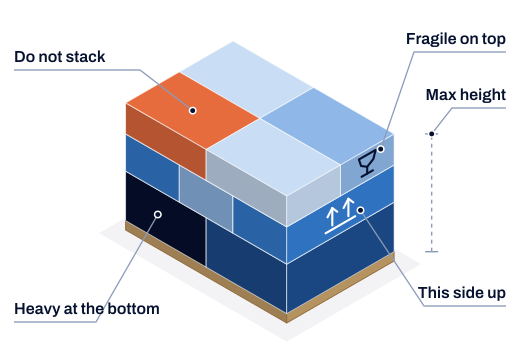
The truck's centre of gravity can only be as low as the pallets on it. Heavy cases at the bottom keep each pallet stable and its centre of gravity low, and light or fragile cases go on top. The same rules apply to palletization in general: weight limits, maximum height, orientation and do-not-stack items.
Plan where each pallet goes on the truck
Spread heavy pallets along the length of the load space instead of grouping them at one end, and keep them centred from side to side. Calculate the axle loads for the plan before loading, with the method from the example above. 3D truck load building adds stacking, rotation and loading sequence to the same plan when loads get mixed.
Re-check multi-drop loads and weigh when you can
On a multi-drop route, check the axle loads after each planned drop as well as at departure. A weighbridge reading per axle is the final check, and GOV.UK advises weighing the vehicle to find the individual axle weights where possible.
Where Pulse fits
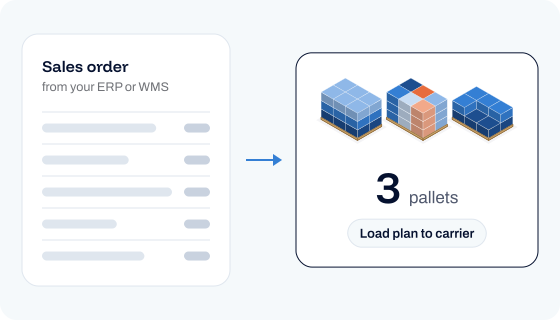
Pulse handles the pallet side of this plan. It calculates the pallet count and pallet configuration when a sales order is created, from item dimensions and weights. It then builds each pallet under weight, height, orientation and do-not-stack rules, with heavy items at the bottom, and shows operators where every case goes with 2D step-by-step instructions.
Across customer deployments, Pulse lowers transport cost by 10 to 30%. To estimate what guided pallet building is worth in your own warehouse, use the palletization ROI calculator, or download the 3D palletization product sheet for a one-page overview. Other ways to bring freight spend down are in warehouse tools that reduce transport cost.
Questions?
Axle weight is the weight that one axle, or one group of axles such as a tandem, puts on the road. It includes the axle's share of the vehicle's own weight and its share of the cargo. Each axle or axle group has a legal limit of its own, separate from the gross vehicle weight limit.
In EU international traffic, Directive 96/53/EC allows 10 tonnes on a single non-driving axle and 11.5 tonnes on a driving axle. A trailer tandem may carry up to 20 tonnes and a trailer tri-axle up to 24 tonnes, depending on axle spacing. On the US Interstate, the federal limits are 20,000 pounds per single axle and 34,000 pounds per tandem, within 80,000 pounds gross and the bridge formula.
Multiply the load weight by the distance from the front axle, or the kingpin on a semi-trailer, to the load's centre of gravity, and divide by the wheelbase. That gives the share on the rear axle or axle group, and the rest goes to the front. Add each axle's empty weight and compare the totals with the legal limits.
Too much weight on the steering axle makes steering hard and can push the axle over its limit, which is 10 tonnes in EU international traffic. Too little is a problem too: when weight shifts too far to the rear, the steering axle can become too light to steer safely. Both come from where the heavy pallets stand in the load.
Yes. Axle limits apply on their own, and in the EU the axle limits of a tractor and tri-axle trailer add up to more than the 40-tonne gross limit. A 40-tonne combination with its heavy pallets grouped at the front can put the drive axle several tonnes over its 11.5-tonne limit while the total stays legal.